Update, Lipmann's periodic table did not go up according to two of my readers, so I "copy & paste" this one from wikipedia:
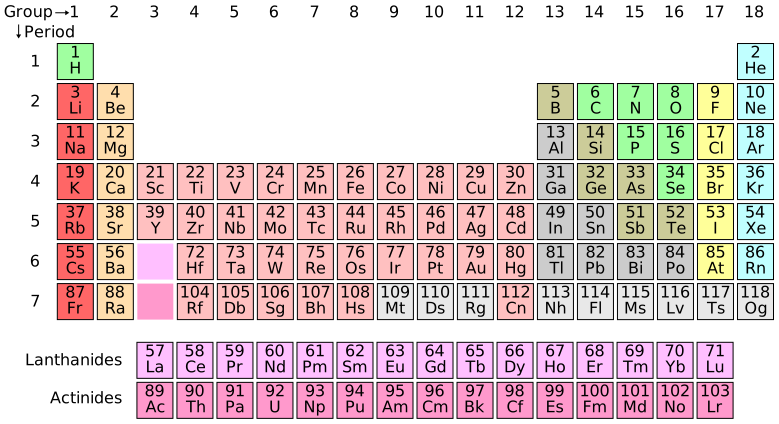
The rare earth metals, are strictly speaking, the ones in the 15 metals from Lanthanum (La) through Lutetium (Lu) in the second last "row" above of the elements, these are also referred to as "the lanthanides". But, in the rare mining sector Scandium (Sc) and Yttrium (Yt) are also considered to be rare earths, as they have similar chemical properties and are often found together with the 15.
Sc has atomic number 21, Yt has 39, and La - Lu have atomic numbers 57 - 71. Detailed chemical and atomic properties will not be discussed in this article except where the applications of these metals are mentioned.
The mineral ores of the rare earths are the relatively obscure monazite and bastnasite. I studied Geology in college, and until I looked into the rare earths, I had never even heard of these minerals.
***
The rare earth metals are really not all that rare, but it is hard to find them concentrated enough to profitably mine. Currently China produces over 95% of rare earth metal production and processing. China a year or two ago imposed export quotas, much to the dismay of end-users.
These metals have many uses, typically in small quantities, most uses are in high technology applications. These metals are also used in many military applications, there is some anxiety in the military-industrial complex and the Pentagon, but while our government has talked about it, they have taken no actions.
To a degree, it is possible to replace some applications of rare earths with other metals, and that is being actively investigated. But, many applications pretty much need the rare earths...
***
Below each rare earth metal is briefly discussed, much of the below information on each metals is from wikipedia as well as from a presentation from Avalon (a company with a mine in NW Canada) and the rare earth metals blog: http://www.raremetalblog.com/. You can get a free email update everyday from that blog.
Lanthanum (La) is mostly used in nickel-metal hydride batteries, these are the batteries used in the Toyota Prius, each Prius uses some 10 kg - 15 kg per car. Other applications are use in lighter flints (often as "mischmetal": alloys of rare earths), hydrogen sponge alloys (to store hydrogen gas), and for lighting and glass applications. Lanthanum is cheap and very available.
Cerium (Ce) is the most common rare earth metal, and availability is not an issue. It is used in glass polishing (cerium oxide) and as catalysts (both in automotive catalytic converters and industrial catalysts).
Praseodymium (Pr) is used alloyed with magnesium in some jet engines, in some magnets, as well as a yellow-green colorant for glass and mischmetal lighter flints.
Neodymium (Nd) is probably the most well known of the rare earths, it is used mostly in neodymium-iron-boron magnets, Nd2F14B (one of the strongest magnets there are, some 20 times stronger than typical iron magnets). These magnets are found in wind turbines, and are essentially not replaceable in wind turbines. The Toyota Prius uses about 1 kg of Nd in each vehicle. Nd is also used in "NdYAG" lasers (neodymium, yttrium, aluminum and garnet), along with other metals. Nd is also used in glass and lighting applications.
Samarium (Sm) is used in samarium-cobalt magnets (slightly weaker then the neodymium magnets mentioned above), an advantage of samarium-cobalt magnets is that they keep their magnetism at higher temperatures than neodymium-iron-boron magnets (but see dysprosium further below). It is also used as catalysts (almost all of the rare earths have catalytic properties), in magnets and a radioactive isotope (Sm153) is used in the cancer drug "Quadramet".
All isotopes of Promethium (Pm) are radioactive, it is found in nature in only tiny quantities and has no applications.
The above rare earth metals are often referred to as the "light rare earth elements" (or LREEs). In general, the "heavy rare earth elements" (HREEs) discussed below are more rare and cost more. They also have interesting applications.
Europium (Eu) is used mostly for red phosphors on monitor screens and TVs. Like red? Then you need Europium. Eu also is used for other colors, as it has two "oxidation states" that are common, unlike most of the other rare earths. Eu is also used as a phosphor in euros (glows red) as part of the anti-counterfeiting measures of making euros. Eu is expensive...
Gadolinium (Gd) is used in magnets and has an unusual metallurgic property: 1% Gd improves the workability and resistance in iron and chromium alloys.
Terbium (Tb) is also used in magnets and as a yellow-green phosphor. Tb is expensive...
Dysprosium (Dy, the name comes from the Latin "hard to find"), is used in small quantities to make the neodymium-iron-boron magnets mentioned above to be "more permanent", that is, dysprosium helps keep those magnets magnetic at higher temperatures. All the wind turbines used them. Dy is expensive... Dysprosium is arguably the most important of all of the rare earths, in that it is rare but very necessary in permanent magnets.
Holmium (Ho) has some interesting properties: Holmium has the highest magnetic strength of any element and therefore is used for the polepieces of the strongest static magnets. Because holmium strongly absorbs neutrons, it is also used in nuclear control rods. (Wikipedia). I do not have other information on holmium other than what I retrieved from wiki. Holmium does not show up in much of the mining literature...
Erbium (Er) is used in neutron absorbing control rods as well as in lasers and glass. Most of the rare earths are used in laser and glass applications. Nor does Er show much in the press...
Thulium (Tm) is the second rarest rare earth (only radioactive Promethium mentioned above is rarer), Th is used is lasers, as an X-ray source and in high-temperature semiconductors.
Ytterbium (Yt) has a host of minor applications (source of gamma rays, doping of glass and metals), wiki writes that its electrical resistance goes up as the metal is stressed, so it is used in gauges measuring earthquake movements. Yb is also under consideration to replace magnesium in infrared decoy flares (much higher emissivity in infrared than magnesium). The Germans are also looking at making an optical clock that uses a single ion of Yt that is accurate to 17 digits after the decimal point. If you want learn more, wikipedia is your starting point...
Lutetium (Lu, named after the old Latin name for Paris) is the last of the rare earths. It is the hardest and densest of the rare earths. Due to its rarity, it has little commercial use, although Lu is being looked at for various high-tech applications (including for bubble memory).
Yttrium (Y, yttrium, erbium, terbium, ytterbium all have similar names because they were first found near Ytterby village in Sweden, Sweden has some rare earths and they may start mining it soon) is not strictly a rare earth metal, but it sits just above lanthanum (La) and so is chemically similar. It is typically found with the rare earths. Its applications include lasers (and related garnets), color phosphors, as a material enhancer (reducing grain size in and strengthening of alloys) and in superconductors (an alloy containing Y is superconductive at a higher temperature than liquid nitrogen -- making it more economical).
Scandium (Sc) has few applications, but it is used to alloy aluminum making its stronger. Russia controls most Sc production, and parts of the MiG-29 fighter jet uses a scandium-aluminum alloy.
***
OK, whew! So how can we invest in this sector to make some money? It is pretty hard to get the metals themselves (and most of them oxidize in the air), although Lipmann does make a market in some of them (in small quantities). And because the prices are volatile (down recently), it does not seem to me to be a viable "investment".
There are a host of small mining companies all trying to get rare earths into production in various countries. Most of these are very speculative, and (IMO) most will likely fail, or in some cases taken over. Let's look at some companies in the rare earth sector (the charts ALL look terrible...: stockcharts.com)
Molycorp (MCP), a US company that used to dominate world production of many of the rare earths before China ramped-up production and drove them out of business due to BIG rare earth deposits, cheap labor and lax environmental laws... Molycorp was brought back to life (partly by Goldman Sachs,, LOL...) and MCP is bring their Mountain Pass (California, near Las Vegas) mine back into production soon, and they are building processing facilities. Mining is not where the big money will be made, it will be made by the processors of rare earth oxides and material makers (those who can make the materials that Toyota and GE need). Molycorp JUST received shareholder approval from Neo Material Technologies of Canada (read all about it at: http://www.raremetalblog.com/2012/05/the-best-rare-earth-company-in-the-world.html) to be taken over by MCP. This is a big step, as Neo does such downstream processing, and sells such processed rare earth products to end-users already. Molycorp produces almost all LIGHT rare earths however, so they are not yet a full spectrum supplier, and there are integration risks, etc.
Lynas (of Australia, ticker LYSCF on the "pink sheets") is the other rare earth miner soon to be producing processed product. They are soon to be opening their processing facility in Malaysia, but there are protests among the locals... (Why didn't they just build their plant in some remote part of Australia...?) Lynas will be approximately the same size as American MCP, and is similar in that they will produce the light REEs. Assuming their Malasian facility is allowed to produce, then Lynas will soon be a real player.
A smaller company called Great Western Minerals Group (GWMGF, also on the pink sheets) apparently does have processing facilities as well. They own a mine in South Africa that they are hoping to get into production soon.
The above three companies are, to my knowledge, the only three soon to be in real production and have processing components (again, where I believe the money is). The below companies are much more speculative IMO because they are miners only and may not be able to get up to speed (financing etc., the usual problems in the small mining sector...).
Avalon Rare Metals, Inc. (AVL on the NYSE) has a big deposit rich with the more desired HREEs... The problem is that the deposit is located WAY up north in NW Canada and it will be years before they can get into production (2017 or so). Avalon is talking about opening their own processing facilities, perhaps in the USA.
Rare Element Resources (REE) has a mine in Wyoming that they are hoping to get into production soon. I have not seen any talk about them processing however.
Ucore Rare Metals Inc. (UURAF, pink sheets) has a deposit on one of Alaska's islands, which also apparently has decent amounts of the heavy rare earths. Alaska is a mining friendly jurisdiction.
Discussion of the above companies
I just read a good article on the rare earth miners (an interview with Jon Hykawy by The Critical Metals Report, read the interview (from 25 May 2012, so very current): http://www.theaureport.com/pub/na/13348). Hykawy believes (as do other authors at http://www.raremetalblog.com/) that the likely winners will be the first ones to get REE products out into the market. Even those with high quality deposits (like Avalon) will lose if they don't get product out SOON. Nor will be it the company that will produce at the lowest cost. The race will be won by the swift... Hykawy likes GWMGF and MCP. He is looking at Lynas to see how they dcome along in production.
I would concur with Hykawy, though HE is the expert not me! My single pick would be Molycorp (MCP) as lots of information is available about them, and they do seem serious about vertical integration. Check out the video (with nice music) re MCP's construction of facilities at their Mountain Pass mine: http://robertmixblog.blogspot.com/2012/01/aerial-video-of-molycorps-new.html
Perhaps AVL and UURAF would be good candidates for Molycorp to take over someday, as they apparently have nice HREE deposits...
But, ALL of the above are very volatile... Do not use money that you cannot afford to lose...
Disclosure: I am considering buying MCP myself, a small stake.
