Showing posts with label Bitcoin. Show all posts

Wednesday, March 4, 2015

Experiment: Saving a .pdf with proofofexistence.com


My blog is on "Hiatus", and for at least a while to be only used for my idiosyncratic uses...

The below experiment is sending a hash of a .pdf file (two pages) for permanent placement on the blockchain.

goo.gl hash of this article: http://goo.gl/va382z


*   *   *


-- File Name (Home Computer):

file:///C:/Users/Owner/Documents/Projects/IJG-141218AMERU.PDF


-- Description:

a .pdf file of our latest Invoice from Iljin of Korea


-- Downloaded and saved 4 March 2015, starting time approx. 23:30 US ET


-- proofofexistence.com hash ("Document Information"):

1bb311f3da1388bdde59926c8d0b0b77f673e8d4b6249b48c20c507fd3e5503b


-- proofofexistence.com wallet address:


-- Amount (Bitcoin) sent to above wallet ID:

0.006


-- Blockchain block number:

346236


-- Blockchain hash number (Transaction ID), my payment:


-- Blockchain hash number (Transaction ID), their placement of my document on the blockchain:

c047350beb9e40ee4a02cfd9e158d6c7bb01712dac1ec5c44a6a0a2264723e60


-- OP_RETURN via blockchain.info (c047350beb...):

OP_RETURN 444f4350524f4f461bb311f3da1388bdde59926c8d0b0b77f673e8d4b6249b48c20c507fd3e5503b 
(decoded) j(DOCPROOF � �� ���Y�l� w�s�Զ$�H� P��P;


-- Other output (coinsecrets.org):


346236
5 Mar 2015
5:29 GMT


--  


OP_RETURN (via blockchain.info, "decoded part") magnified, note symbol (red):

DOCPROOF � �� ���Y�l� w�s�Զ$�H� P��P;


-- Public Note (best viewed via blockchain.info, "my payment" transaction ID above):

Public Note: IJG-141218AMERU.PDF


Remarks:

1)  Yes, proofofexistence waits for a confirmation...  This takes an average of 10 minutes.  It can take quite a bit longer (and is in this case, this block took 40 minutes to be found).

2)  Yes, proofofexistence confirms my hashed document is now on the blockchain successfully encrypted, placed and hash number confirmed.


Wednesday, November 12, 2014

Bitcoin No. 10, "The Ringer" And Provident Metals

A nice series of events has come together lately to provide some information that I hope is of use or interest to you dear readers.

I continue to dabble in Bitcoin, even with its price volatility.  Just today (Weds., 12 Nov) it has spiked majestically, up some $60 (or 16%)!  I was lucky to buy some BTC over the past 10 days or so while the price was in the $300s (so, yes, I "BTFD").

I bought an interesting new product from Fisch Instruments ("The Ringer"), a device which allows you to "ring" a gold coin (or silver or platinum) to check to see if it is counterfeit.  The Ringer will be discussed below.

Also discussed below (after The Ringer) is my buying experience with Provident Metals, which is one of at least four precious metals suppliers who accept Bitcoin as payment.

*  *  *

I have now gained some experience in a limited amount of the Realm of Bitcoinistan.  Almsot all of this I have written about in my various pieces in the "Fun with Bitcoin for Beginners" series I started late in 2013 as I was learning.  Recently I have continued buying, mixing and now spending BTC (spending for just the second time).

It is hard for me to find actual PEOPLE to buy BTC from in my area, so I have found that the service that works the best for me is trucoin.com, who now will sell BTC by credit (or debit) cards in some 22 states.

Once I have the new BTC, I like to "mix" (aka "tumble" or "launder") them through two different services, in sequence if possible.  These are the same two I have written about before:

bitmixer.io

and

sharedcoin.com

So now I typically buy some BTC through trucoin, then mix them through (first) bitmixer and then through sharedcoin.  I believe the latter service is only offered through wallets used with blockchain.info's wallet service.  (blockchain.info is perhaps the premier monitoring service of the vital BlockChain infrastructure of Bitcoinistan, I strongly encourage everyone to tour their interesting website)

So, Step One (for me) is buying the BTC from trucoin (the only real drawback is that you do not have the privacy offered if you are able to buy from a person that you meet).  Once the incoming BTC are "confirmed (typically 8 - 15 minutes, but can be as long as 12 hours...), I then will send them (Step Two) on to bitmixer at the first opportunity.  Their service takes anywhere from 20 minutes - 12 hours, depending on confirmation times (I do not know why sometimes it takes so long to get transactions confirmed).  Once the BTC arrived "mixed" from bitmixer (and confirmed), I then run them through sharedcoin (Step Three), doing the pair of transactions bitmixer first and sharedcoin second means that I am likely to have less "taint" after multiple transactions...  Less taint (and running the BTC through two different mixers with different algorithms) also means that very few hackers *as best I can tell) would be able to follow my BTC trail.  Privacy.  It's one of the things that Bitcoin is all about...

Simple, right?  Steps One, Two and Three.  Well, OK, I have a system down with which I am reasonably familiar, but there can be snags...  The Bitcoin Ecosystem is a little clunky (like the Internet was in 1994, say, or PCs when they used early versions of DOS...).  Clunky and (alas) somewhat error-prone.

I have had three "incidents" (problems) come up in the past three weeks or so. All three were resolved OK, I lost nothing, but my BTC did seem to be in peril.  I will mention a bit on each incident, how it was resolved and how you can try to prevent similar from happening.  OK, but, the very nature of the infrastructure of Bitcoinistan now is that these kinds of things are likely to happen.


  1. My problem with trucoin arose because I had a new debit issued (with a new expiration date, of course) which did not match the one in trucoin's system.  Updating and untangling this took part of a day, but I was not in a real hurry.  Their team solved the problem pretty quickly and amiably.  Bravo!  Apparently (a guess) my situation was that a debit card change was not programmed into their software, they actually thanked me for helping to improve their service.
  2. I also had a problem with sharedcoin, although this was several weeks ago.  There was a glitch that happened right during the mixing process, I never got my BTC, yet they were sent (left my wallet).  Yikes!  I got through to their Help Desk, where the man suggested I try to recover the "intermediary wallets" (part of their mixing system).  And I was able to recover them.  Whew!  But, I learned an angle, so on balance the experience was worth it.
  3. The other day I had my problem with bitmixer.  I am not sure exactly what happened, but the mixing process was taking very long, uncharacteristically so.  The transactions I sent them were possibly confusing as well.  It took a fair amount of back & forth with them to recover my BTC, my guess is that it was an involved process because they wanted to be sure that I was not scamming them and that they would be sure that the errant BTC actually DID belong to me, and that they needed to be SURE.  I am going to guess that there is a lot of scamming going on in Bitcoinistan, the fact that BTC transactions cannot be "undone" makes it attractive for cyberthieves to try taking away money...
I learned three general rules that may help:

--  Follow instructions carefully!  <== Very important!  Document your actions.
--  Work in a calm and considered way with the service provider, with all info possible
--  Be patient, some problems work themselves out on their own (confirmations)

*  *  *

In my travels around the Internet, I found out that Fisch instruments (the makers of the fairly well known, well known among people who collect gold coins anyway, Fisch balances to detect counterfeit precious metal coins) also came out with a new product called "The Ringer".

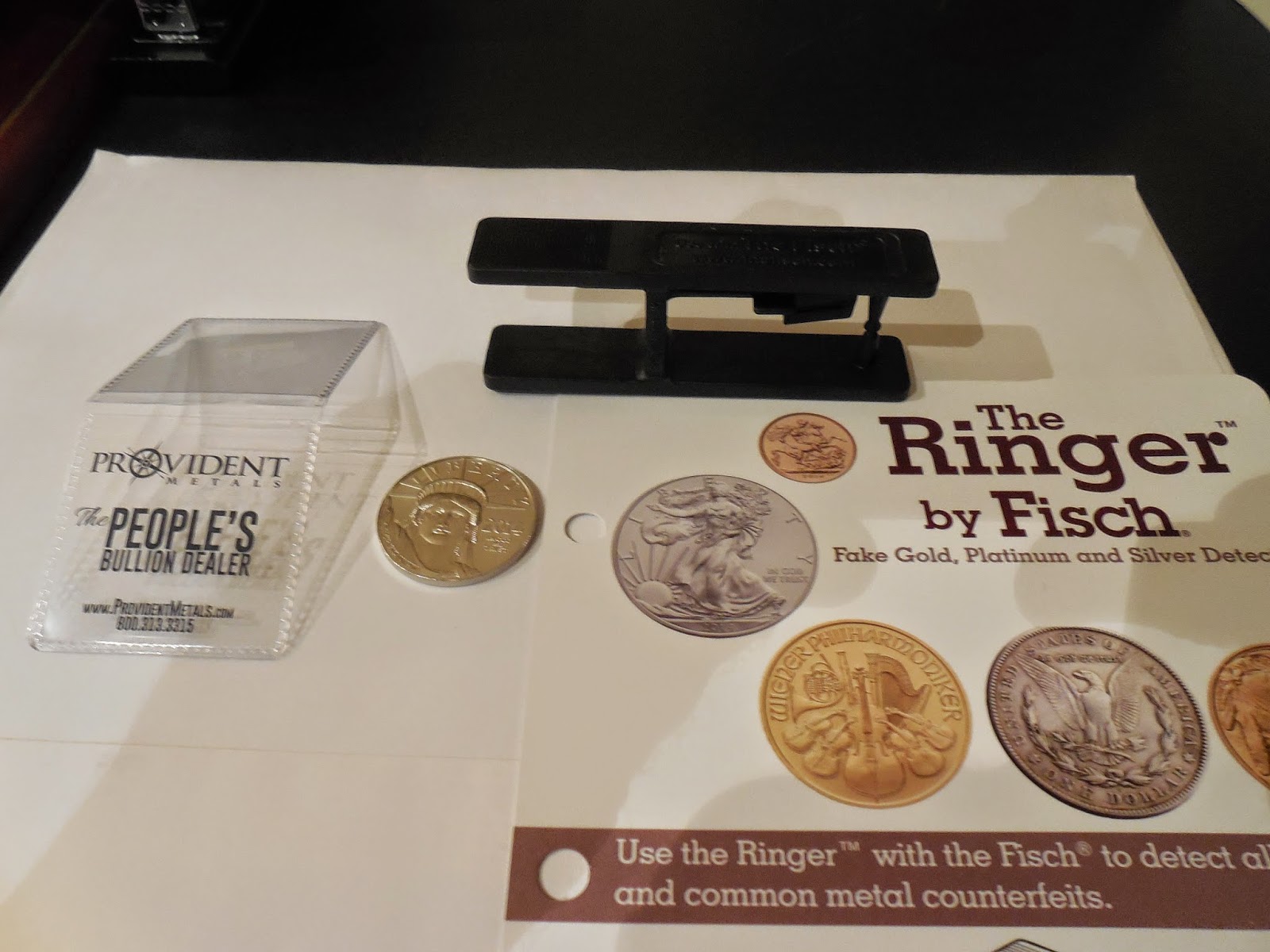
The Ringer is a plastic device that holds a coin in its jaw and that has a plastic hammer that strikes the coin to produce a characteristic "ring".  Most metals (in coin form) will ring at least a little bit (but not post-1982 pennies (zinc), lead "coins" or, importantly, tungsten).  Here is a photo of The Ringer (black plastic near the back) with a page from their notebook (showing pictures of coins on the right) as well as my recently arrived platinum coin (a Platinum Eagle (USA) from Provident Metals (center-left):

The Ringer, page from Fisch (right) and Platinum Eagle from Provident

All coins will have a distinctive ring.  The exact sound-signature of the ring depends on the metal (or alloy), the exact shape of the coin, and its size.  A fairly easy way to learn about different rings of coins is to get a modern (1965 and later) quarter and a silver quarter (1964 and earlier, you know, when those coins were made with silver), and drop one of each onto a hard surface (a granite countertop or bathroom tiling both work fine).  The silver quarter has a ring that is very distinctive vs the modern "clad" quarters.

The Ringer is precision-made to test the ring of coins, it works best on 1 oz coins, but will work on smaller ones as well.  I have not yet tested The Ringer on smaller coins, but I did test them on a few 1 oz precious metals coins I have in my own collection.  Here is a photo of my recently arrived platinum coin mounted in the jaw of The Ringer, ready to be tested:


The plastic hammer is not shown distinctly here, but is just below the left edge of the coin.

The Ringer is best used with a pen (or screwdriver in my case) to bend the hammer down so it will snap up and strike the left edge of the coin:


When the hammer strikes the coin, the coin will have a distinctive ring that is somewhat different than any other different coin.  In the case of a Platinum Eagle, it rings, but the ring is subdued and goes away in less than one second.  Here are some other "quick & dirty" results from my coin testing two nights ago (all 1 oz coins):

--  Platinum Maple (Canada), a dull ring similar to the Pt Eagle tested above
--  Palladium Maple, a nice ring, somewhat high tone, went on for several seconds
--  Silver Eagle, a decent ring, lasted several seconds
--  Gold Eagle, a very nice ring, went on and on (like a Chateau Latour...), beautiful!
--  Gold Buffalo (USA), a dull ring
--  Gold Kangaroo (Australia), another dull ring

I am very satisfied with The Ringer and will likely buy another.  And probably one of their balancesa as well (to test weight and dimensions of Gold Eagles).  The Ringer cost me $104.00 (delivered), it took a bit over a week to arrive from when I mailed my check.

See more (including an audio as well as a video) at their website: thefisch.com.

*  *  *

I was also very satisfied with my just arrived Pt Eagle from Provident Metals.  I bought the 2014 piece, which I have not seen (yet) at the coin shops I have been to.

The US Mint only re-started minting them after a pause of about six or seven years.  {latinum Eagles are kind-of hard to find!  For me anyway.  Also the price that Provident offers them at is at least $50 less than the coin shops (if the latter had them).

I received the coin in three business days after ordering.

I also paid with Bitcoin!  This was the second purchase I have made with Bitcoin (I bought a 0.25 oz Gold Eagle late last year).  They do want 1% more for BTC payment (vs. a wire transfer or check), but that is not much for the convenience and speed of paying by BTC.

Provident has a wonderful selection of precious metal coins!  Here is a link to their 2014 Platinum Eagle:

http://www.providentmetals.com/2014-1-oz-american-platinum-eagle.html

Provident has some kind of relationship with Elemetal LLC, my guess is that Elemetal owns Provident, but I am not sure of that, they do, at a minimum, have a special relationship.  See the very interesting website of Elemetal LLC:

http://www.elemetal.com/

Elemetal is a prime advertiser in American Hard Assets, the magazine I review on occasion.  I mentioned a while back that I was eventually going to try to learn more about Elemetal, as it seems to be very large (it owns Ohio Precious Metals, the largest gold refiner in the USA for example).

Watch this space, then...

Friday, September 26, 2014

King Dollar?

Lately we have seen almost everything go down vs. the US dollar.  Other currencies, gold & other commodities, almost everything investable (except, arguably US Treasuries, which have performed extremely well in recent years much to my surprise).  This almost begs for an examination of US dollar recent performance as well as discussing likely future prospects of the dollar versus other investments.

First I would like to show what has been happening lately with the dollar compared to some of its alternatives, I just use the "US Dollar Index" (I believe it is some 50% composed of the Euro, and almost all of the rest is the Japanese Yen and the UK Pound).

Most of what I present below is from stockcharts.com which a free (but limited) service. To my knowledge, stockcharts does not track Bitcoin, so I had to go elsewhere for that chart (see below).

 Here is the US dollar over the past six months, this is a measure of the strength (going up) vs. weakness.  *Click* on any image for a better view!


All three marked indicators show very strong performance by the US$.  7% in a little under three months is a very large move in foreign currency terms.  The dollar has moved up big vs. the Euro (now just under $1.27), and the Japanese Yen (109 Yen to the dollar).  The UK Pound is around $1.626 (it has not fallen as much as the Yen, Euro and Ruble).  The Russian Ruble is near a new low.

  • Sidebar: Speaking of the Russian Ruble and Russia, I will mention that the Ruble is very low as Western sanctions bite, and I wonder (woooh, conspiracy theories!) if the US .gov is working with Saudi Arabia to beat the Russians down "a la Reagan" by cutting Russian hard currency income because of lower prices for their exported oil.  I do not think this the case for lower oil prices, as oil and everything else has been going down lately.  But, I promise that I will get around to looking at a conspiracy theory or two before too long...

Of interest to technical analysts, here is a rather amazing chart, note how the dollar's recent move is very impressive even looking back two years...:


Each of those little red and white bars are what the pros call "candlesticks".  I cannot recall EVER having seen 10 white ones in a row...

*  *  *

OK, most of the foreign currencies (that would also include the Peruvian Sol for those interested) are down vs. the dollar.  What about gold?  Gold over the last 6 months, note that at stockcharts.com that the ticker for gold itself is $GOLD, and may differ slightly in its price movements from the gold ETF (ticker: GLD), the GLD is "paper gold"...


Notice how gold moved almost exactly inversely with the dollar.  US$ up, gold down.  Not pretty for gold owners!  Here is the sad story for the past two years:


Note how gold (priced in dollars) is essentially at a "triple bottom" (for anyone interested in technical trading), this is usually NOT a good sign...

Six month crude oil ("West Texas Intermediate Crude"):


Crude oil is moving very similarly to gold, down!  Note the rather orderly "channel" (gray lines) from about $107 per barrel (late June) to $93 and change now, a decline of about 12%.  Note also the ominous-sounding "Death Cross", this is a pattern where the 50-day moving average (blue curvy line) crosses over (downwards) below the 200-day moving average (red curvy line, less volatile), while at the same time the prices are below both.  I do not have statistics as to whether a Death Cross has any predictive value or not, but the technical traders watch these kinds of patterns closely.

Gasoline prices seem to have edged down just a bit, not much, but a little.  I have not had to pay $70.00 to fill up my SUV in a month or two, smile...  Gasoline prices are "sticky" to the downside, that is, when crude goes up gasoline goes up right away.  But, when crude goes down, there is a lag time..., they do not cut prices as quickly as they raise them, hmm, funny that.

Bitcoin 6 month chart, note eerie similarity to decline (with gold) since early July (source: bitcoincharts.com):


Bitcoin has gone down some 30% from its recent (July) peak.  But, Bitcoin is extremely volatile!  Bitcoin topped out at over $1100 last December, when the craze was going full-blast (yes, that was the general time-frame I started learning about and buying BTC...).

6 month cotton price, ugh!  A slowdown in China figures into here too...


That "Death Cross" business (50-day moving average (blue) crossing below 200-day (red) with prices even lower about July 9) looks like it predicted lower prices.  Cotton, like many commodities, has its own price dynamics and is influenced by weather (for example) in cotton-producing areas.  (Gold is not really influenced by weather, strikes, etc.)  But, China is importing much less cotton currently.

I had to take a "screen shot" of this next chart, it is an index of food and beverage prices of the last few months and is only through August.  But the general trend is clear, DOWN!  I know nothing about this particular index, but it would appear that in the aggregate, wholesale commodity food prices are down about 7% (again, April - August).


Source: indexmundi.com

*  *  *

STOCKS have been somewhat positively correlated with the dollar.  Although last week was down and volatile in the stock market, stock prices have been surprisingly weakly correlated with the dollar, stocks in general ARE up (and near all-time highs), but the price action only somewhat similarly matches the dollar movements.  It is possible that foreigners are buying dollars more aggressively than buying US stocks, but that is just a speculative thought on my part.  Because the correlation is somewhat weak, I do not put the chart in here, but you can look at it (the S&P 500, the most important stock index for the pros) here:

http://stockcharts.com/h-sc/ui?s=%24spx

Normally (but things have not been "normal" since at least 2007...), the US$ and the longer-dated US Treasury bonds move together (positive correlation).  But they have not, the 10-Year Treasury price chart appears to have very little correlation with anything!  See for yourself if you don't believe me:

http://stockcharts.com/h-sc/ui?s=%24ust

I can offer no explanation for this -- the Treasuries not being strongly correlated with the US dollar.  QE (or at least the "Taper") is slowly ending, which MAYBE would push prices down some, but that MIGHT be balanced by foreign (or other) demand for a "safe haven" investment.

*  *  *
Bottom Line:

The US dollar has indeed been King Dollar recently.  Nothing else seems to match it, nor do I have a ready explanation based on price movements (at least the ones above).

Will this continue?  Is the US$ really the King?

Or is it just the "cleanest dirty shirt in the closet"?

Hmm, we will have to wait and see.  Because I do not know.  But, something seems very wrong with this latest King Dollar...

How do we deal with this?  If ("a big if") this trend continues (and it might, deflation -- at least short-term -- is a threat), one way is to have plenty of CA$H.  Dollar goes up, the value of cash does too.  But it is safer ONLY if you have at least some of it outside of the banks!

Saturday, August 2, 2014

$50 Bills, Iridium, Bitcoin App For iPhone

In my article today, I decided to tie together three recent things that all (somewhat) tie in to inflation.  First, I believe they are lying to us, again.  Second, I wanted to show a couple of, well, unusual, ways to fight inflation, even if they are not practical for most people, but they are interesting!

I was just at CVS the other day buying some items.  The total came out to some $23 or so, and I did not have a $20 bill and enough smaller ones to cover it (I was at the automated check-out machines).  So, I asked the gal standing nearby if the machines accepted fifty-dollar bills.  She said yes, and she was right.  I got my change back all in order.  Here is our $50 (*click* any image for a better view):

Current US $50 Federal Reserve Note

But this reminded me of something about the US $50 FRN I ran into maybe a year or so ago.  The ATM that I normally use changed their payout from 25 * $20 bills (for $500, my limit) to FIVE $20 bills and EIGHT $50s.  I mentioned this in a blog piece, and asked if others of you were having similar experiences (getting fifties from the ATM, I had never seen that before in the USA, in Europe yes, I had seen 50 euro notes and smaller come out of their machines in Italy, for example).

I now have little trouble getting even a small retailer to take a $50 for small purchases (like at 7-11).  When I was young, sometimes retailers would complain if I tried paying with a $20 for very small purchases.

So, it looks like the $50 has become "the new twenty".  Several years ago, I hardly ever even SAW fifties, but now I get them, and spend them everywhere.

This is yet another sign of inflation.  More currency coming into the system.  Barron's, the weekend financial paper, shows ("Federal Reserve Data Bank", page M49 in my edition) that "Currency in Circulation" is about $1.284 trillion, up some 88.9 billion from last year.  That works out to some 6.8% increase in actual currency supply.

In my eyes, that translates to 6.8% inflation.

Also the Fed numbers show the total growth on their Balance Sheet: a growth of $840 billion to a new total of $4.450 trillion, that is a growth of some 23%.  Almost all of these "assets" are government debt...

So, depending on how you want to look at it, there is at least an inflation of 6.8%, perhaps quite a bit higher.  I think that 6.8% is a reasonable minimum figure for inflation.

As is so typical, it looks like they are lying to us as usual.

(Next time I go to CVS, I will ask them if the machines take $100s...)

***

Within the past week or so my one troy ounce of iridium arrived!  Iridium is the second heaviest (stable) element that exists, it is just barely beaten out by osmium.  The density of iridium is 22.56 g/cc and for osmium the density is 22.59 g/cc, essentially identical (just 0.13% difference).  For reference, platinum has a density of 21.45 g/cc (so some 5% less) and gold comes in at 19.30 g/cc.

But, the form I bought the iridium was in "Iridium Sponge", which turns out to be 60-mesh powder (very fine (small) particles).  It came sealed in a jar, if I break the seal, then should I choose to sell it, it would have to be carefully re-weighed and assayed, I do not know how much that would cost.  But, I have no interest in selling this iridium!  At some point I may want to test it, to see if it is real (iridium is perhaps the most resistant of all of the elements to chemical attack).  Use of hydrochloric acid would probably be a good test, iridium should resist it (not dissolve or change).  This one troy ounce cost me $709...

One troy ounce of Iridium, 60-mesh powder

Note the fine powder I "stacked" up for clarity, the color is indeed a dark gray.  I put a US $5.00 gold piece next to it for scale.  This iridium comes from preciousmetalpurchase.com, I got it about two weeks after mailing a personal check.

Iridium in "sponge" form is how it is used in most applications.  About 198,000 ounces of iridium are used worldwide each year.  The below is a chart showing use of iridium over the past few years (chart from Johnson-Matthey):


J-M notes that 178,000 ounces of iridium were used in 2012, I cannot reconcile that number vs. the other I recently read (198,000 ounces), maybe 198,000 is from 2013 (?).  Nor can I explain the the over 300,000 ounces used in 2010 and 2011.  Iridium is a very specialized material...  Iridium is used mostly for crucibles for growing single-crystal sapphires used in LEDs for TVs (from http://en.wikipedia.org/wiki/Iridium).  Iridium is very hard (6.5 on the imperfect but well known "Mohs Scale"), has a very high melting point and resists almost every chemical attack in town.  It is also used in lesser quantities for high performance spark-plugs (racing cars for example) and in catalytic applications.

Recently a new supplier has come along offering exotic metals for "investors".  I had bought a pellet (blob) of osmium some time ago (http://robertmixblog.blogspot.com/2013/02/what-is-this.html), and in my internet explorations about a month ago I found this company: Rare World Metals Mint.  One of my "virtual friends" (from zerohedge.com) alerted me to the fact that this private mint was now selling iridium in a "nicer" form, with a stamp, purity, serial number, etc.  Here is a picture of their new product, a one ounce ingot of iridium (their RWWM and Globe logo is stamped on the other side):


Very nice!  Here is their web page describing their iridium: http://www.rwmmint.com/products/iridium.  The only real problem: they want $1595.00 for it!  Yikes!  Maybe the price has gone up lately.

But, I now own four of the six Platinum-Group Metals: platinum (Pt), palladium (Pd), osmium (Os) and now iridium (Ir).  If I want to complete the collection, all that is left are rhodium (Rh, available from kitco.com in Baird 1 toz bars) and ruthenium (Ru, also available from Rare World Metals Mint: http://www.rwmmint.com/).  Their website is very interesting for people interested in exotic metals, highly recommended!

***

Many fans of Bitcoin ("BTC") have a mobile "app" that they can use to make purchases of products with their BTC that they may have in their wallets on their smartphone.  Almost all of these BTC apps were on "Android" (Google's OS, used in more smartphones than any other) devices.

Recently (maybe a week ago or so ago), Apple came to their senses and has now allowed at least one BTC app to be used on their iPhones as well.  Rumor had it that Apple wanted to make their own cryptocurrency, but it seems that enough people were ditching their iPhones for Androids because they liked BTC so much.  Who knows?

But, I installed the app by blockchain.com (note that is blockchain.COM, well known blockchain.info is apparently their owner though).  Installation of this app required an hour-long upgrade of Apple's operating system (I have an iPhone 4S, old!, and then a few minutes for the app itself.

So here you go!  blockchain.com takes you here, the installation is easy (ha ha):


I am still trying to figure out everything involved with this app, but the key features are the ability to have your own wallet in your iPhone so you buy things with your BTC as well as receive them.

Remember this!  Bitcoin sells at a huge premium in Argentina now!  Argentina has capital controls in place that prevent their citizens from easily defending themselves from high inflation.  While BTC price is very volatile, it is likely to outperform Argentine Pesos (LOL...).

Saturday, July 19, 2014

Fun With Bitcoin For Beginners: Part Nine

This article will look at three topics:

1)  A very large number!  And other wallet matters
2)  How to create a blockchain.info wallet (the easiest way to get a wallet)
3)  A new service that allows you to buy Bitcoin ("BTC") with a credit card

***

Recently I was engaged with a BTC service which involved getting a new wallet.  I messed something up and then lost that wallet!  I then wondered if there was any cost (to me, or to the BTC Ecosystem) in losing or discarding wallets.

An example of discarding wallets would be someone very concerned about privacy who would use a wallet once (for one transaction), and then never using that wallet again (giving the owner more privacy, sort-of like the "One-Time Pad" in encryption in days gone by).

For this discussion, I will use a genuine BTC wallet that does not belong to me:

1BitmixerEiyyp3eTLaCpgBbhYERs48qza

The wallet belongs to the mixing service bitmixer.io.  Note that all BTC wallets start with a "1" followed by 33 other alphanumerics.  In this case, the eight letters following the "1" are part of a "vanity wallet" (similar to vanity license plates on cars), more further below.  What I am interested in looking at here is the NUMBER of possible wallets based on the fixed-length of a Bitcoin wallet ID.  Normally BTC wallets have a random string of alphanumerics, which is probably best (there have been some problems with those who have vanity wallet IDs...).  I have now looked at quite a few wallet IDs, and pass along the below remarks for setting up some arithmetic:

a)  26 capital letters + 26 capital letters + 10 digits = a theoretical 62 alphanumerics
b)  But, I have seen, No capital I's ("I"), NO capital O's ("O") and no small l's ("l")
c)  I have seen NO zeros ("0")
d)  This would yield some 58 alphanumerics, I may have missed something, so say 55

Note that these 55 characters can be used in any of the positions 2 - 34 in a wallet ID. So, we are looking for a number that would be approximately 55 to the 33rd power ("55^33"):

-- 55^2 (55 squared) = 3025 (first two characters after the "1")

-- 3025^2 (55^4 =  55 "to the fourth power") = 9,150,625  <- from here I will simplify by rounding

-- 55^8 ((55^4)*(55^4)) = approx. 81,000,000,000,000 (81 trillion)

-- 55^16 (81 trillion * 81 trillion) = approx. 6,561,000,000,000,000,000,000,000,000  (this would be 6.561 octillion, or (6.561 * (10^27)), a large number.

-- 55^32 ((55^16)*55^16)) = approx 43 sexdeciilion (aka sedecillion) or about 43 * (10^51)

-- 55^33 = approx. 2.365 septendecillion (2.365 * (10^51))  <-- (10 followed by 51 zeros)

Reference on large numbers here: http://en.wikipedia.org/wiki/Names_of_large_numbers

2.365 septendecillion is the largest number I have ever calculated on my own.  Keep in mind that I rounded DOWN and only used 55 alphanumerics (instead of some 58 or so).  So my number is almost surely too low!  But, even if I am off by a factor of 1000, that is still an extremely large number!

That would work out to about 300 duodecillion wallets for every man, woman and child on Planet Earth, so no worries if you lose a wallet ID (as long as there was no BTC in there)!

[Ed. Trivia Note, when I was some eight years old, our family dictionary listed numbers up to vigintillion or 10^63]

***

I briefly mentioned "vanity wallets" (vanity address) above.  There are services that will allow you to "make" (discover might be a better term) wallets with some of the first characters you would want.  Here's an article discussing this:

https://en.bitcoin.it/wiki/Vanitygen  <-- this shows some coding for programmers...

Here is one way to do it yourself (looks hard):

http://www.rentadesk.co.uk/blog/2013/4/2/how-to-create-a-vanity-bitcoin-address

There may be services that will do vanity addresses for you.  But, be careful!  Maybe just sticking to the random wallets is safer, and hides your own personal identity and safety a little better...:

http://www.reddit.com/r/Bitcoin/comments/21foj9/funds_currently_being_stolen_from_vanity/

***

In my Part Five (here: http://robertmixblog.blogspot.com/2013/12/fun-with-bitcoin-for-beginners-part-five.html) I explained how to get a wallet from MultiBit, a free program you can download that allows you to make wallets, receive and send Bitcoin, study transactions, change passwords, etc.  MultiBit requires downloading though, and some people don't like downloading programs that they are not familiar with, especially if your computer then asks you to download Java (by Oracle), which one of my computers did.

So, here is another way to get a BTC wallet that is easier yet apparently secure.  It is also free, and is done using blockchain.info, the respected Bitcoin service.  Some time ago, my source "Bitcoin Insider" ("B.I.") told me the following (words may not be exact):

There is a low but non-zero probability that your coins could be stolen. 

The way I interpreted THAT was "engineer-speak" for "low risk".  I am comfortable with the wallet (and its "spawn" as each time you use their sharedcoin.com mixing service it throws off a brand new wallet for you).  So, the below is a step-by-step procedure for having a wallet at blockchain.info.  Note that blockchain.info does NOT have your password!  You lose or forget your password, you LOSE any BTC in your wallet!

1)  Go to blockchain.info, you will get a page that looks like the below (*click* on any image for a better view), note the red oval I drew around the (faint) gray word "Wallet" near the top center:


2)  Click on "Wallet", and this page appears, next click on "Start a New Wallet" (inside my red oval):


3)  You will then get something very similar to this.  Fill out the fields with the green arrows (the email (first) is optional, but I did it, and then blockchain.info gives you a code that you can use instead of your wallet ID, see further down).  The fourth arrow is a "Captcha" (all you old-timers from ZH have seen this!) the Captcha is used to keep "robots" from misusing blockchain.info.  Note the red arrow!  Do not lose your password!


Upon finishing these steps and clicking the "Continue" (bottom green), you will arrive here:


Keep the above word string!  It will allow you to recover (somehow...) a lost password.  Then "Continue" and you arrive here:


Enter your Identifier, if you have done all of this on one computer it will likely already be entered for you (it is an alias, blockchain.info sends it to your email and then you enter your password).

And then you will arrive here (edited for privacy).  You will have a QR-Code as well as your new wallet ID right there!


You are now ready to go and buy or send BTC!  Of course, to send them, you need to BUY some first...

***

If you are lucky and know someone who will sell you BTC for cash, then you are good to go.  You can also try localbitcoins.com to try and find someone who will sell you BTC.  I have had "reasonably good" results with localbitcoins, but, alas, there just are not that many in my town who are out there with BTC for sale for cash.

But, there is a wonderful brand-new service that allows you to buy BTC by credit card (or debit card).  They charge a 5% fee "over spot" (my favorite (free) BTC price service is ounce.me).  Of course buying by BTC by credit card DOES leave a "digital trail", so those very concerned with privacy perhaps may not want to do this...  They now operate in eight states, go to their website to see if you are in the lucky eight:

trucoin.com

They require some hoops to jump through.  These include credit card info, a scanned ID (Driver's License) and probably some other things (same mail address as billing address, etc.).  But, the process is not onerous.  Here is their Home Page:


You have to sign up via a Google, Facebook or LinkedIn account.  Once you are "in the system" you are good to go.  Here is what I did just the other day:


Note that there is a friendly "Need Help?" blue button at bottom right.  I needed some help as I had "issues" with the process.  And note the $6.00 they tacked on as a fee, but that is not that much, if you factor in trying to meet someone "in town" and all that, the cost is pretty reasonable, IMO.

Once you you are in their system and you successfully complete a transaction, you will see a satisfying screen of "BTC pouring into your wallet", and when that is done, this will be your receipt:


Congratulations!  You will then be an owner of (more) BTC!

Monday, July 7, 2014

Fun With Bitcoin For Beginners: Part Eight

This article will look at securing and making Bitcoin (BTC) transactions more private.  There is some built in privacy even though all BTC transactions are recorded on the Blockchain (and so some of that information is available to anyone who is interested enough to look).

This article is in the same spirit as those about gold in that everyone who can should have some assets that are not easy to grab...  Even though BTC are not "off the grid" in one important sense (that BTC is very hard to use without the Internet), it is a place to put money (value) that is properly done is secure and reasonably private.

The two topics I will examine are using a computer not easily linked to you as well as other techniques using BTC itself to better conceal your ownership.

A pair of topics I will not address here are TOR and email encryption, these are both topics beyond my scope (at least for now).  Rumors also abound that TOR is not as secure as believed (that NSA has cracked TOR for example), I am not in a position to offer an opinion on that.

***

I read some months ago that buying a used laptop (at an anonymous place like a pawnshop for example) and then using the wifi at places you typically do not go is an effective tool to provide some privacy.

So, I went and bought a used laptop ($190 (included sales tax, paid cash) plus a $40 program I will use to clean up the garbage left on the hard disc).  That $190 included very little software, but I do not plan to use the laptop for my blogging nor data analysis uses...  I did not have to show any ID when I bought the laptop, nor did I get a receipt.  And of course I will not be downloading any nosy software...

What I have done with it so far is to establish another email account (only to be accessed with that laptop) as well as opening another BTC wallet.  There are two easy ways to set up BTC wallets:

1) via MultiBit (see: http://robertmixblog.blogspot.com/2013_12_01_archive.html)

2) via blockchain.info:

    a)  https://blockchain.info/
    b)  click on "wallet" (faint gray button at top): https://blockchain.info/wallet
    c)  start a new wallet (follow the easy directions: https://blockchain.info/wallet/new

Either will work fine with a "new used" laptop.  Both are easy to use.

Once you have a new wallet, NO ONE will know about it!  That's the beauty of using a laptop that no one knows about.  Then you find a way to get BTC into your wallet, preferably quietly...

***

Recall that one way to get BTC to a new wallet is to send some from another wallet that you own.  If you are going to bother trying to keep your BTC transactions from easy inspections (meaning that only relatively skilled and determined opponents would be able to see what you are doing) then there are two techniques that I have identified that will shield you to a degree:

1)  Mixing services (discussed at: http://robertmixblog.blogspot.com/2014/05/fun-with-bitcoin-for-beginners-part-six.html)  <-- Note that the link has a mistake in the title, this article is indeed "Part Seven" even though the link says "-part-six.").

2)  Use a "daisy chain" of wallets that will at least slow down and hounds on the trail.

I will now write about point 2 with a look at an example of a large and somewhat lengthy and complex set of transactions.  Complexity and length are likely to be your friends here!

Here is a hash code of a recent transaction (July 7) for about $135,700:

f85f743ed49d799f440061db8894f430bcf459aeb5290e49e96098a51cf40c12

Click that hash code into the search box at blockchain.info, and you will get this, *click* on image for a better view:


Now click on the "donor wallet" (sending wallet), 15NC2synrqTNymM4gbY85PWxq6Fcj87PKK.

Then keep clicking back on each donor wallet before that, and so on.  After clicking back through some 45 wallets (!), you will see various transactions along the way, each one sending a large amount and typically see many smaller amounts sent along, here is an example "along the way back":


Note that these transactions (all +/- 45 of them) all took place in just a few days (July 5 - 7).  Note that the two above transactions were about 30 minutes apart.  To keep "clicking back", click on the "donor wallet" each time.  You will get many pages of pairs of transactions just like immediately above.

I used the above set of transactions as an example of how to obscure a trail, I have no idea who this is, but here is what you get when you keep going back in time, have a look at the interesting transactions "at the end":


and


That last wallet (wallet ID starting with "16R14EH...") is involved in over 10 pages of transactions at the end, including the one just above for over $1,000,000.

So what?  Well, I am going to guess that the owner of those BTC owns all of the wallets, but imagine the work it would take someone to work through all of that.  Yes, the BTC wallet IDs are there, but to track down the origin and trail of the BTC "seems like" would be rather hard...

Now imagine combining the above technique (perhaps even harden it further by using only any wallet only ONCE) along with the BTC mixing services described in my Part Seven.

***

There are apparently other ways to "mix" your BTC.  Some of the exchanges allow you to send them BTC -- and then withdraw them at your leisure.  Once you get the BTC back they are already mixed.
  You would want to use an exchange that has no "Know Your Customer" ("KYC") regulations for BTC to BTC transactions (I have been told that there are one or more).  Note that all exchanges now operate under those KYC regulations if you want to receive or send CASH for BTC.

There are likely other techniques that I have not run into (beyond using the TOR network).  Many of the people involved in Bitcoin are are very bright and of a libertarian temperament.

Monday, June 23, 2014

Liquid Alt: Gold, CA$H And Bitcoin

Almost everyone maintains some kind of liquidity, it is just natural to want to have enough money around to cover the necessary things in life: food, rent/mortgage, gasoline...  Most of people's liquidity is in banks, checking and savings accounts.  In this article, I argue that that may not be good enough, that everyone should try to own liquid assets outside of the financial system.

The USA and the world as a whole suffer numerous financial problems.  In recent years we read about people in Cyprus being "bailed-in", that is having some of their account money actually removed by their government, kind of a tax.  There are now numerous proposals being floated in the US and Europe to allow similar actions if the government so decides, "in extremis" of course...

Many of us have also read that the FDIC only has some 1% of its total possible liabilities should there be widespread bank failures.  Maybe the customers of the first few banks would get paid (ah, but only up to $250,000 -- in total, that figure is for the total of all of your banks accounts).

***

In the event of a "crunch" or other serious negative financial event, I believe that everyone (who can) should already own all three of these "Liquid Alternative Assets":

-- Gold (and/or other precious metals)
-- Cash, actual FIAT currency, perhaps four months worth
-- Bitcoin, diversification, mobility and a "Lotto Ticket"

NO ONE can predict the future!  We can make guesses and informed choices however.  Prudence would dictate owning at least something of the above in case of massive bank failure...

I offer the same suggestions to all readers outside of the USA as well!  Just tonight I read that the controversy in Germany about them NOT getting THEIR gold back from the Federal Reserve Bank of New York is making news again...

***

Most of you kind readers already know that I strongly believe that EVERYONE (with savings) should have some physical gold.  I suggest 5% - 20% of net wealth in gold.  Having 5% of your (net) wealth in gold puts you into "the 1%" (that is, 99% of people own NO gold, except for jewelry).

And I do not mean buying the GLD (the ETF for gold) or other "paper gold" (futures, etc.)!  Buy the gold, not the gold miners.  Buying gold miners is buy shares in companies.

Gold has been valued by humanity for at least 5000 years.  The ancient Lydians started "minting" gold coins about 550 BC.

Gold coins (especially, for Americans) the Gold Eagle or the Gold Buffalo) are probably the best way to get started.  Gold Eagles are available in sizes as small as 1/10th of an ounce (would cost about $160).

Silver is often called "the poor man's gold".  Silver is better than nothing, but if I had to pick ONE, I would pick gold.  There is no harm in buying some silver (or platinum) once you have a starter position in gold.

***

Since the banks are paying 0.1% (or less) of interest for your money in the bank, why not just take some OUT of the bank?  There is a real risk that banks may wind up losing some or all of it should bad things happen...

Since you receive essentially no interest on your money, there is essentially no "Opportunity Cost" (loss of possible income) in just holding some of your money in CA$H!  Just find a safe place for it...

How much cash?  The "survival" websites suggest around three - four months of family expenses.  Of course, in the event of big financial problems, "family expenses" might very well go down.  Again, hide it well, maybe even have TWO places, one easier to fool the burglar or other robber...

***

I also am feeling more and more confident that Bitcoin (BTC) is likely to be here to stay.  And that "almost everyone" with some extra "money", and the ability to get it, should own some BTC.

Before I get to my arguments as to why I recommend owning BTC I would like to show one apparent change in the fast-moving world of Bitcoin.  There are new entrants into the mining pools (blockchain.info/pools, image from about 5:15 PM US ET), *click* on the image for a better view:


People who closely watch the "mining pools" (groups who put hundreds or even thousands of special ASIC computers that work together to solve the "math problem" to mine BTC) will recognize the large blue slice GHash.IO, who has been grinding away in first place for as long as I have been looking at these charts (eight months or so).  GHash.IO typically takes some 30% - 49% (but they briefly did go over 50%) of the hashing power ("tera-hashes" in BTC mining jargon), which is closely correlated to BTC won by the miners.

But, there are new players!  Note KnCMiner (fourth place, 7%, "purple slice") and AntPool with some 3%.  Both of these miners are apparently owned by bitcoin mining equipment manufacturers!  In other words, KnC and Bitmain (the latter makes AntMiner rigs if I have this information right) are front-running their own customers!  The above chart illustrates what has long been rumored, that customers of these manufacturers are suffering long delays, because the manufacturers are using their own machines!

Bitcoin mining looks like it is no longer worth it to anyone but very highly capitalized groups who can also take advantage of things like having a data center, low electricity costs, and mining on a very large scale.

(The above also shows other new players, other mining pools that until recently have not been seen there: Polmine, "1AcAj9p" and "1BX5YoL".  Polmine is out of Poland, CloudHashing might be the guys in Iceland,  the other two mentioned here I know nothing about.)

***

As is the case with gold, don't "buy the miners", nor mining equipment, nor invest in "cloud-hashing"!  The rate of return in every case I have looked at is negative.  Buy the BTC!

Buying BTC is not for everyone.  There is a basic (it's hard though) set of knowledge that you must have to know how to buy and spend BTC.

But, you can use BTC in many places in the world now.  Argentina, for example, has severe financial problems (brought on by their government) and BTC has become rather popular there, going for a PREMIUM of some 30% - 50% over BTC prices here in the USA.  In other words, if you take enough BTC with you, you could make money (and pay for your trip) by selling BTC there in Argentina.

Bitcoin can be taken with you on your laptop, a flash drive, or even on a piece of paper ("paper wallet").  If you have a wallet at blockchain.info (there are others too offering wallets on the web), you do not need anything, just access to the Internet anywhere!  What this means is that you can move HUGE amounts of capital very easily (of course you need the capital to buy BTC), taking it out of the country if you need to in nearly complete secrecy if you do it right...

Sunday, June 8, 2014

304517: A BIG Bitcoin Block: $126,000,000!

Alert new Bitcoin observer "OROBTC" noted a large amount of money (gross flow, not net) pass by the blockchain recently:

 304517 -- A BIG Block!  (Read 1134 times)

Link here:

https://bitcointalk.org/index.php?topic=641879.0

***

Now when a guy like me sees such a huge number as $126 million + cross the wires, I take notice.  So I clickly quicked the link at blockchain.info (they scroll near-real-time transactions on the blockchain), I saw some nice information.  Remember, all information on the Blockchain is PUBLIC, although as I mentioned in my "Part Seven" article (a couple fo articles below), there are ways to cover your tracks reasonably well.

Just for perspective, here is a screen shot of blockchain.info's home page, showing latest Blocks, with gross amounts paid out (as always, *click* on any image for a better view, note that my anti-virus program took the opportunity to advertise itself (bottom right), LOL...):


The "Total Sent" column shows a bit over $30,000,000 (total) "sent" from the last six Blocks (math problems solved almost exclusively by the mining pools, note how BIG GHash.IO solved four of the last six).  Miners also make money from transactions (like when I bought my 0.25 oz Gold Eagle for BTC, I paid by Bitcoin, and it went via BTC Guild, another large mining pool, that transaction for some $365 cost me about $0.12 -- 12 cents!) as well as winning the 25 BTC.

Note the Block numbers ordered chronologically in the left column in the above image, the last Block awarded was number 304833.  Blocks are awarded about every 10 minutes on the average, so the above image is fairy typical.  Typically, if a long time goes by without a "win", the amount awarded is larger.  Note that 304832 was for a gross of over $10,000,000 (to mighty GHash.IO) because there was a relatively long 17 minute gap between "wins".  GHash.IO also processes a lot of transactions, so those 10-cent fees can add up,,, smile.

***

But, I wanted to explore the BIG Block: 304517!  Here is some information I was able to glean from blockchain.info itself as well as comments from "Bitcoin Insider" (, "B.I.", who, alas, informed me that these eye-popping amounts "sent" are not net amounts, more below.  Here is the info from Block 304517 (enter that into the Search feature at blochchain.info, definitely *click* the next two to see yummy details):


Hmm, another one of those reported form the Gulf of Guinea (0 degrees Lat., 0 degrees Long.).  There is a lot of interesting "inside baseball" information there, note the hash info at upper right, recall that miners have to "solve a math problem that shows they figured out the solution with an initial has of some 14 zeros..., that ought to give anyone an idea of why it is pools of thousands of ASIC computers that solve most of these).


Note, I scrolled down that page a bit for the below information too.  The first group is the dollar value of the 25 BTC "created" when the block was solved, this went to BTC Guild, if I understand correctly, it was only some $16,400 and change).  The other amounts below show transactions and fees.  Note that all of this is not very clear to an outsider (like me).


Below the 25 BTC award is the amount transferred that made the blow so big: almost $116,000,000!  You can see that a bit over $114,000,000 went to one wallet, and a bit over $1,000,000 to another.  Clicking on the "hash code" of this transaction yielded:


There are two interesting things to note (to a beginner!):

1) Only $1,304,000 was actually sent ("net") here

2) The transaction fees were ZERO!  Ask your bank if they will transfer THAT much for free!

Because so much of this is confusing for a beginner, I asked the help of B.I. for some explanation of what I was seeing.  Here is part of his response (in blue):

Robert,

Only about 2 1/2 Million dollars was actually transferred to other wallets. If you examine the transactions there appear to be consolidated wallets with extremely large balances sending small round number outputs to other wallets. This is just like what I discussed with you last week. My personal wallet was consolidated into a single address when I made a new wallet and transferred a variety of funds from years of activity. 

OK, what he is saying here is that wallet balances with large balances "seem" to send out large amounts (but the total net received by all the other wallets in this block was some two and a half million dollars), but many Bitcoin users often see these kinds of numbers at their own transactions (as have I: WHAT was going on with the amount of BTC I had that I did NOT send in a transaction?!?!).

OK, I sort of understand what he has been writing me, but one day I am going to have to ask him for a complete course in "Bitcoin Transaction Interpretation"...

Looking into lucky recipient 1Drt3c8pSdrkyjuBiwVcSSixZwQtMZ3Tew , we can note that 1Drt... was involved in a large number of transactions:, the below just shows the latest part of MANY others, it appears that this may be a part of a set of transactions between BTC Guild and an exchange (more in just a moment):


bitcointalk.org members "Phinnaeus Gage" and "bryant.coleman" have comments that lead one to suspect that perhaps that 1Drt... wallet may belong to one or other of the exchanges (bitstamp maybe?), but I was unable to understand their comments, I am not "there" yet... (see the comments No. 31 and 32 from them at the bitcointalk.org link near the top of my article, these two people are senior members of the forum and appear to know a lot, why it would not surprise me to see "OROBTC" thank them very soon with a link to here...!