Monday, August 4, 2014

President Ebola

Yes, yes, I understand that the title above is very inflammatory, but I cannot help but believe that this President has contributed, at a bare minimum in part, to several public health issues (all related to communicable diseases discussed here).

It is also very important to note that this story is moving very quickly, everything I write here is subject to being "old news" within a day or two (or even proven untrue in some cases).

I will not speculate what policies of other Presidents might have done re the two US citizens with Ebola (Dr. Kent Brantly is now being treated in Atlanta and (nurse, I believe) Nancy Writebol is en route), perhaps compassion might have been shown to both health workers who went to Africa to serve the poor in countries with Hellish conditions.  And it is important to be humane in treating our citizens, I respect that.

Nonetheless, there are reports (which I cannot verify, at least yet, this may change soon, if so, I will definitely be editing this piece...) that Ebola might be considerably more contagious than previously thought.  By air perhaps.  Apparently several health workers were fully suited-up in protective suits, and yet they still caught it.  Theories abound...

The current mainstream thinking, as far as I can tell, is that there is no real danger to the two US citizens being brought back to the USA for treatment in Atlanta (Emory University's hospital, and close to the CDC).  But...

Ebola in West Africa (from the Mirror of the UK, dated August 1, link: http://www.mirror.co.uk/news/uk-news/ebola-outbreak-moving-faster-efforts-3950599), does not include new cases in Nigeria or in Ebola's "traditional" epidemic zones in Sudan, etc.  The same report says SIXTY health care workers have already died from Ebola in this epidemic...


Here is a map of US Quarantine Zones (from Yahoo via zerohedge.com):


Here is a current ABC story on our two citizens to be treated in Atlanta (at time of writing only Dr. Kent Brantly is in treatment, Nancy Writebol may be leaving W. Africa today (Monday, August 4)):

http://abcnews.go.com/Health/wireStory/liberia-orders-cremation-ebola-victims-24830289

The ABC report above mentions an "experimental anti-serum", Dr. Brantly reportedly received it.  The ABC report above shows Dr. Brantly arriving at the hospital, in his containment suit, but walking on his own.  ABC said he may be getting better.  ABC also reports that Dr. Tom Friedman (Director of the C.D.C.) is saying that any treatment for Ebola is still at a very early stage.

There are a LOT of conflicting claims (as you would expect) about whether Ebola is real or not (including an early "Ebola denier" at Zero Hedge) as well as claims of how contagious it is, etc.

Many of the doctors who caught Ebola in West Africa were apparently "suited-up" and already taking extensive precautions (eg, three pairs of gloves).

My own thought (and this is subject to change very quickly) is that our two citizens might better have been treated at one of our military bases already in Africa or on a hospital ship, just in case...

And who decided, and with what rationale, to allow the two American Ebola victims into the USA?

* * *

Along our southern border there are wildly conflicting reports of illegal immigrants including sick children) who have a variety of communicable diseases.  We already know from a leaked intelligence report from Customs and Border Protection (multiple sources, Google it!) that illegals immigrants from 75 countries have been detected (including 71 people from countries now infected with Ebola), it is not clear if they are being detained or what their current status is.  Over 1000 of these illegals are from China.  Other illegals are coming from Pakistan, Yemen, etc.  You get the picture, there are national security threats as well as public health issues...

Here is a link kindly contributed by ZH member "Pinche Caballero" (he provided a link to: 
https://lexingtonlibertarian.wordpress.com/tag/bedbugs/), I have seen these kinds of reports.  But a Wordpress blog (even if it provides information similar to what I have heard before) cannot be considered authentic unless verified by other sources.

Bedbugs (already in NYC hotels, um, NOT fun)
Scabies
Dengue Fever
Hepatitis A-E
Tuberculosis
Chagas Disease
HIV
Chicken Pox
Leprosy
But, The Guardian, a major and respected but somewhat leftist, newspaper out of the UK reports that reports of "epidemics" of communicable serious diseases along out southern border are not true (as well as other reports of criminals, dispersal of immigrants, etc.)...:

http://www.theguardian.com/commentisfree/2014/jul/15/immigration-myths-debunked-border-crisis

This piece is from July 15 (three weeks ago).  And I have my doubts as to how much faith we can have in The Guardian's reporting here.

There are other links and reports, both saying this (illegal immigrants bringing dangerous diseases with them) is a big problem, and other reports that deny that.

* * *

Nonetheless, all of the reports I have heard and read about re conditions at border camps housing the current wave of illegals are very bad especially re overcrowding.  Overcrowding invites outbreaks of contagious diseases...

One of the main "jobs" of our federal government is to maintain security along our borders.  This Administration has failed to do so.

This President has failed.  He has failed our Constitution by imposing ObamaCare.  He appears to be failing in his duty to protect and defend our country (never mind the Constitution).  He has earned the nickname I have given him, he is the most toxic president we have ever had.

President Ebola

Saturday, August 2, 2014

$50 Bills, Iridium, Bitcoin App For iPhone

In my article today, I decided to tie together three recent things that all (somewhat) tie in to inflation.  First, I believe they are lying to us, again.  Second, I wanted to show a couple of, well, unusual, ways to fight inflation, even if they are not practical for most people, but they are interesting!

I was just at CVS the other day buying some items.  The total came out to some $23 or so, and I did not have a $20 bill and enough smaller ones to cover it (I was at the automated check-out machines).  So, I asked the gal standing nearby if the machines accepted fifty-dollar bills.  She said yes, and she was right.  I got my change back all in order.  Here is our $50 (*click* any image for a better view):

Current US $50 Federal Reserve Note

But this reminded me of something about the US $50 FRN I ran into maybe a year or so ago.  The ATM that I normally use changed their payout from 25 * $20 bills (for $500, my limit) to FIVE $20 bills and EIGHT $50s.  I mentioned this in a blog piece, and asked if others of you were having similar experiences (getting fifties from the ATM, I had never seen that before in the USA, in Europe yes, I had seen 50 euro notes and smaller come out of their machines in Italy, for example).

I now have little trouble getting even a small retailer to take a $50 for small purchases (like at 7-11).  When I was young, sometimes retailers would complain if I tried paying with a $20 for very small purchases.

So, it looks like the $50 has become "the new twenty".  Several years ago, I hardly ever even SAW fifties, but now I get them, and spend them everywhere.

This is yet another sign of inflation.  More currency coming into the system.  Barron's, the weekend financial paper, shows ("Federal Reserve Data Bank", page M49 in my edition) that "Currency in Circulation" is about $1.284 trillion, up some 88.9 billion from last year.  That works out to some 6.8% increase in actual currency supply.

In my eyes, that translates to 6.8% inflation.

Also the Fed numbers show the total growth on their Balance Sheet: a growth of $840 billion to a new total of $4.450 trillion, that is a growth of some 23%.  Almost all of these "assets" are government debt...

So, depending on how you want to look at it, there is at least an inflation of 6.8%, perhaps quite a bit higher.  I think that 6.8% is a reasonable minimum figure for inflation.

As is so typical, it looks like they are lying to us as usual.

(Next time I go to CVS, I will ask them if the machines take $100s...)

***

Within the past week or so my one troy ounce of iridium arrived!  Iridium is the second heaviest (stable) element that exists, it is just barely beaten out by osmium.  The density of iridium is 22.56 g/cc and for osmium the density is 22.59 g/cc, essentially identical (just 0.13% difference).  For reference, platinum has a density of 21.45 g/cc (so some 5% less) and gold comes in at 19.30 g/cc.

But, the form I bought the iridium was in "Iridium Sponge", which turns out to be 60-mesh powder (very fine (small) particles).  It came sealed in a jar, if I break the seal, then should I choose to sell it, it would have to be carefully re-weighed and assayed, I do not know how much that would cost.  But, I have no interest in selling this iridium!  At some point I may want to test it, to see if it is real (iridium is perhaps the most resistant of all of the elements to chemical attack).  Use of hydrochloric acid would probably be a good test, iridium should resist it (not dissolve or change).  This one troy ounce cost me $709...

One troy ounce of Iridium, 60-mesh powder

Note the fine powder I "stacked" up for clarity, the color is indeed a dark gray.  I put a US $5.00 gold piece next to it for scale.  This iridium comes from preciousmetalpurchase.com, I got it about two weeks after mailing a personal check.

Iridium in "sponge" form is how it is used in most applications.  About 198,000 ounces of iridium are used worldwide each year.  The below is a chart showing use of iridium over the past few years (chart from Johnson-Matthey):


J-M notes that 178,000 ounces of iridium were used in 2012, I cannot reconcile that number vs. the other I recently read (198,000 ounces), maybe 198,000 is from 2013 (?).  Nor can I explain the the over 300,000 ounces used in 2010 and 2011.  Iridium is a very specialized material...  Iridium is used mostly for crucibles for growing single-crystal sapphires used in LEDs for TVs (from http://en.wikipedia.org/wiki/Iridium).  Iridium is very hard (6.5 on the imperfect but well known "Mohs Scale"), has a very high melting point and resists almost every chemical attack in town.  It is also used in lesser quantities for high performance spark-plugs (racing cars for example) and in catalytic applications.

Recently a new supplier has come along offering exotic metals for "investors".  I had bought a pellet (blob) of osmium some time ago (http://robertmixblog.blogspot.com/2013/02/what-is-this.html), and in my internet explorations about a month ago I found this company: Rare World Metals Mint.  One of my "virtual friends" (from zerohedge.com) alerted me to the fact that this private mint was now selling iridium in a "nicer" form, with a stamp, purity, serial number, etc.  Here is a picture of their new product, a one ounce ingot of iridium (their RWWM and Globe logo is stamped on the other side):


Very nice!  Here is their web page describing their iridium: http://www.rwmmint.com/products/iridium.  The only real problem: they want $1595.00 for it!  Yikes!  Maybe the price has gone up lately.

But, I now own four of the six Platinum-Group Metals: platinum (Pt), palladium (Pd), osmium (Os) and now iridium (Ir).  If I want to complete the collection, all that is left are rhodium (Rh, available from kitco.com in Baird 1 toz bars) and ruthenium (Ru, also available from Rare World Metals Mint: http://www.rwmmint.com/).  Their website is very interesting for people interested in exotic metals, highly recommended!

***

Many fans of Bitcoin ("BTC") have a mobile "app" that they can use to make purchases of products with their BTC that they may have in their wallets on their smartphone.  Almost all of these BTC apps were on "Android" (Google's OS, used in more smartphones than any other) devices.

Recently (maybe a week ago or so ago), Apple came to their senses and has now allowed at least one BTC app to be used on their iPhones as well.  Rumor had it that Apple wanted to make their own cryptocurrency, but it seems that enough people were ditching their iPhones for Androids because they liked BTC so much.  Who knows?

But, I installed the app by blockchain.com (note that is blockchain.COM, well known blockchain.info is apparently their owner though).  Installation of this app required an hour-long upgrade of Apple's operating system (I have an iPhone 4S, old!, and then a few minutes for the app itself.

So here you go!  blockchain.com takes you here, the installation is easy (ha ha):


I am still trying to figure out everything involved with this app, but the key features are the ability to have your own wallet in your iPhone so you buy things with your BTC as well as receive them.

Remember this!  Bitcoin sells at a huge premium in Argentina now!  Argentina has capital controls in place that prevent their citizens from easily defending themselves from high inflation.  While BTC price is very volatile, it is likely to outperform Argentine Pesos (LOL...).

Saturday, July 26, 2014

The BRICS Bank: A First Look

Recently one of the big stories in the financial world is the Agreement among the BRICS (Brazil, Russia, India, China and new member South Africa) countries to start a "BRICS Bank".

The most commonly held view is that these five countries would start this bank with the idea of rivaling and maybe even displacing the US dollar as the world's reserve currency.  This "meme" is apparently incorrect.  The "BRICS Bank" is really closer to a version of the 1944 Bretton Woods Agreement (when the World Bank (called at that time the "International Bank for Reconstruction and Development") and the International Monetary Fund (IMF) were founded).  Keep in mind that in 1944, World War II was not even over when they made the Agreement.  The World Bank and IMF both started operating in late 1945.

Important Disclosure!  I would not have been able to write this article without the help of a few individuals, ESPECIALLY one who wishes to remain anonymous.  To my knowledge, all of what I write is true, based on some help I received and my own research.  I thank various correspondents who chipped in various observations as well to make this a better article.

The Bretton Woods Agreement was agreed to by most of the large economies of the world at that time, not includng, of course, German, Italy and Japan (the Axis powers) who later DID join (both the World Bank and the IMF).  China was an original member, Italy went on to join the World Bank and IMF in 1947, Germany and Japan joined both institutions in 1952.  Sources:

http://www.worldbank.org/en/about/leadership/members

http://www.imf.org/external/np/sec/memdir/memdate.htm

There are a lot of parallels between Bretton Woods and the Fortaleza Agreements, some of which I will discuss, though not in a detailed way.  All four of these Agreements are essentially complicated international treaties.

The "BRICS Bank" is actually to be two new institutions: The New Development Bank ("NDB") and the Contingent Reserve Arrangement ("CRA").  The NDB fairly well correlates with the World Bank, and the CRA roughly correlates with the IMF.

The NDB and World Bank mostly (will) focus(es) on infrastructure and similar lending to developing countries.  The CRA and the IMF (will) focus(es) on lending like emergency funding (Greece) and funding to bridge over trade imbalances.

Here are the two relevant paragraphs from the "Fortaleza Declaration" (in blue, link here: http://brics6.itamaraty.gov.br/media2/press-releases/214-sixth-brics-summit-fortaleza-declaration), these show in general terms what the BRICS members have in mind re the NDB and the CRA:

12. The Bank shall have an initial authorized capital of US$ 100 billion. The initial subscribed capital shall be of US$ 50 billion, equally shared among founding members. The first chair of the Board of Governors shall be from Russia. The first chair of the Board of Directors shall be from Brazil. The first President of the Bank shall be from India. The headquarters of the Bank shall be located in Shanghai. The New Development Bank Africa Regional Center shall be established in South Africa concurrently with the headquarters. We direct our Finance Ministers to work out the modalities for its operationalization.
13. We are pleased to announce the signing of the Treaty for the establishment of the BRICS Contingent Reserve Arrangement (CRA) with an initial size of US$ 100 billion. This arrangement will have a positive precautionary effect, help countries forestall short-term liquidity pressures, promote further BRICS cooperation, strengthen the global financial safety net and complement existing international arrangements. We appreciate the work undertaken by our Finance Ministers and Central Bank Governors. The Agreement is a framework for the provision of liquidity through currency swaps in response to actual or potential short-term balance of payments pressures. 

Text of the the two Agreements for the NDB and the CRA can be found here:

http://brics6.itamaraty.gov.br/media2/press-releases/219-agreement-on-the-new-development-bank-fortaleza-july-15

http://brics6.itamaraty.gov.br/media2/press-releases/220-treaty-for-the-establishment-of-a-brics-contingent-reserve-arrangement-fortaleza-july-15

These are long...

The official language is English, I saw nothing written about the Agreements being official in Mandarin, Russian or Portuguese (although, of course, official translations exist for the internal use of each country).

There is one big difference between the two sets of institutions, however.  The World Bank and the IMF have 188 countries as members (almost all countries), while the NDB and CRA have but five.

***

First I wold like to examine a couple of main ideas of both the IMF and the CRA.  One important issue is their participation, that is, how many countries are joining (there are five, although others may be admitted later on), and what their contributions are to be.  The below (in blue) is straight out of the CRA Agreement:

Article 2 - Size and Individual Commitments
a. The initial total committed resources of the CRA shall be one hundred billion dollars of the United States of America (USD 100 billion), with individual commitments as follows:
i. China – USD 41 billion
ii. Brazil – USD 18 billion
iii. Russia – USD 18 billion
iv. India – USD 18 billion
v. South Africa – USD 5 billion

That above funding, take note, is in US dollars!  No yuan (renmimbi), no rubles, no rupees, no Brazilian reals, and no rand.  There is no mention of gold anywhere in the CRA.  The total is $100 billion.
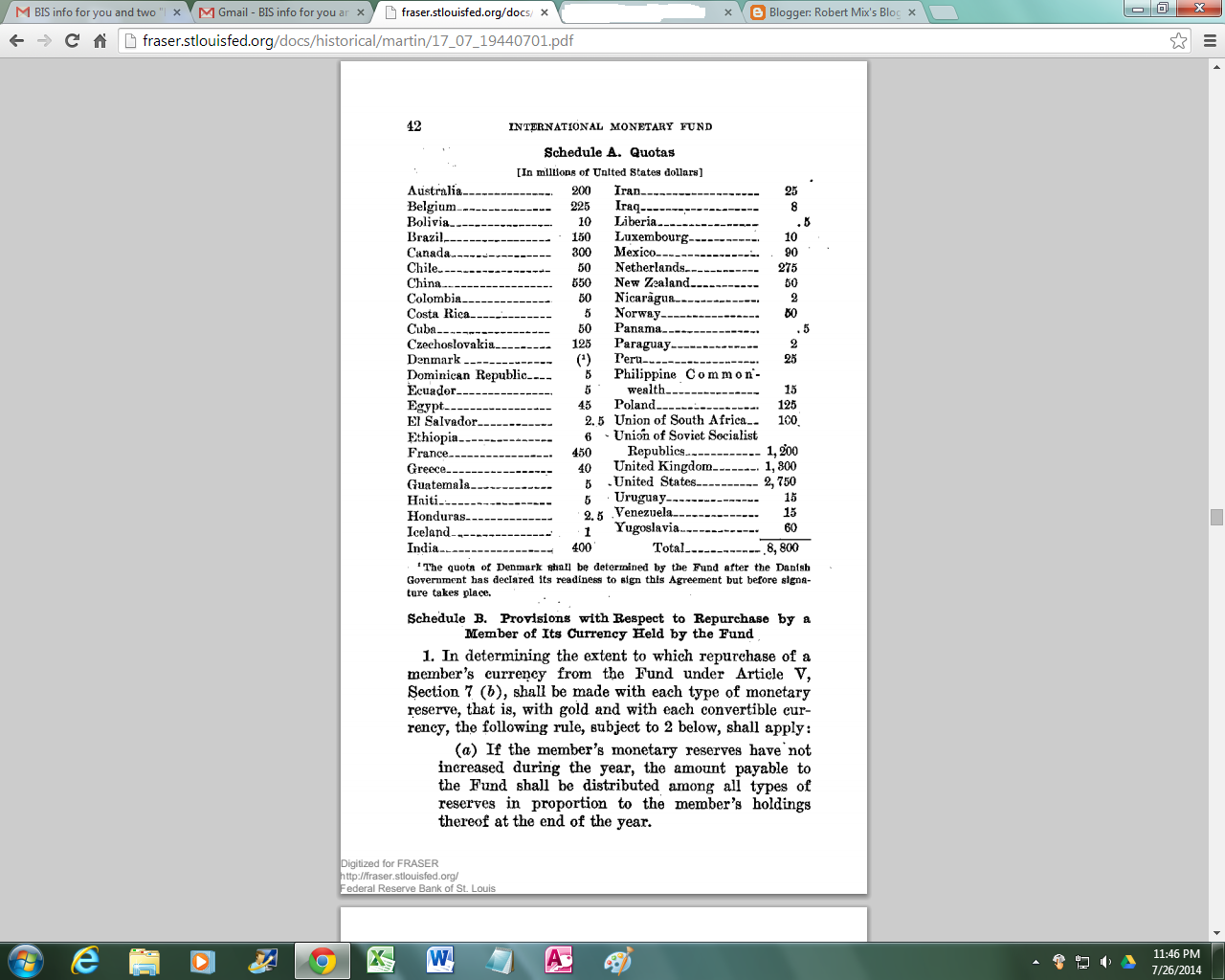
Here are the initial quotas from the 1944 Bretton Woods Agreement on the quotas of the founding countries (you will need to *click* on the image for a better view):


http://fraser.stlouisfed.org/docs/historical/martin/17_07_19440701.pdf (page 52 of the pdf)

Not that it means much, but it may be worthwhile to note that in 1944 the US contribution was about 31% of total IMF contributions, in the CRA China is contributing 41%.  In round numbers (and depending on whose figures you accept), China has as large an economy as all the rest of BRICS put together.

***

Another issue that is important to at least glance at is the role of gold in the four institutions.  The IMF specifically mentions gold, and goes into some detail on gold's role in the IMF's planned operations.  Here is a look at Article Four of the Bretton Woods IMF Agreement (recall that in 1944 that the US dollar was defined as 1/35th of an oz of gold):


Nowhere in the CRA is gold mentioned.

For that matter, gold is not mentioned in the NDB Agreement either.

Yet, I have read Jim Willie CB (rightly) discussing the importance of gold in the near future.  In fact, he has written of "Gold Trade Notes" from time-to-time (in his free reports (he also writes much deeper reports that you can subscribe to), here is his website: goldenjackass.com).  I was curious about the whole notion of Gold Trade Notes (apparently they would function as more-or-less replacements to the traditional Letters of Credit now heavily used in world trade), so I ran a Google search just tonight (early AM, 27 July).  There are quite a few results, but every link I clicked referred back to Jim Willie, I saw NO independent articles discussing the Gold Trade Note that did not refer back to Dr. Willie.  I of course concede that Dr. Willie's sources are much better than mine, there very well could be (likely ARE) private discussions between the BRICS members, especially among those hostile to the US dollar...

In some contrast to what Dr. Willie writes about China and Russia (the two core members of the "BRICS Bank" that are somewhat hostile to the USA), I have read elsewhere that China likely values its trade with the USA more so than their trade with Russia...  While no doubt that China is seeking much greater long-term influence in the world's financial system, it does not appear that China would like to pay a price of bad trade relations with the USA or even Europe (Europe is now China's largest trading partner).

***

Another issue of likely major relevance is the possibility of conflicting goals among the members.  While there is always some amount of disagreement among members of the World Bank and the IMF, the institutions seem to work pretty smoothly in accord with their missions.  They have professionals working for them, who are relatively non-political and often are very talented economists (etc.).  My wife worked for the IMF for some three years, and found the level of professionalism to be pretty high, and the level of (national-level) politics to be pretty low.  (Yes, they DID have very nice Christmas parties, I had the fortune of being invited twice!)

I have reason to doubt that the NDB and the IMF will likely operate at a high level of professionalism and international politics taking a back seat.  Please recall that the NDB and the CRA exist now because the BRICS members are not satisfied with the current structures of the World Bank and the IMF.  These countries do have a case (that they are somewhat marginalized, emphasis somewhat).

It is my opinion that the "BRICS Bank" has been born out of frustration and resentment of the more developed world and the way the industrialized countries instruct the borrowers in what they are allowed to do and what not to do.

Also, note that the original term (acronym) for BRIC's (South Africa was recently added to have an African member) was a marketing slogan created by a Goldman Sachs analyst (Jim O'Neill).  Other than resentment of the USA, Europe and Japan, there is relatively little that unites the current five members of the BRICS other than that they are "surplus countries" (exporting more than they import, and so are owners of a lot of US dollars).  That the five BRICS have joined together must make Goldman Sachs crack a smile...

***

The NDB and the CRA do share many attributes of the World Bank and the IMF.  Funding and voting share are fairly strongly correlated in the NDB and CRA (as with the other two).

The texts of both the NDB and the CRA seem to rule out highly concessionary ("easy") terms, and do appear to impose strict terms and repayment policies.  Lending standards (at least what are int he Agreements) are rather strict.  This appears to be prudent, but if the terms are not much easier, then why would poorer countries go there?  Perhaps the terms are easier if the borrowers agree to buy products "Made in China"...

(Maybe I am missing something)

***

The World Bank and the IMF have come under much criticism, from both those interested in more open markets as well as those who want more "justice".   One of the main sources of frustration among the poorer members of the World Bank, for example, is the voting power (number of shares) of each member.  The voting power is roughly correlated with how much money each member has chipped in, less money contributed, the less influence a member will have...  Also, funding to poverty-stricken (or countries in a temporary bind) is subject to oversight by the wealthy countries having the great majority of shares.

On the other hand, much lending over the years has resulted in money being lost to corruption and cronyism as well as projects of dubious value (dams).

There have been numerous reforms that have been passed and are still being examined by the World Bank and the IMF.  As an example, much World Bank lending is now directed towards "sustainable development" and towards lowering carbon emissions...

Many of these reforms are already in the Agreements of the NDB and the CRA.

***

The prospects for the NDB and the CRA are uncertain, IMO.  There are numerous examples of other international development "banks" that have not gained traction (eg, the Chiang Mai Initiative (early 2000s, in reaction to perceived inaction in resulting from the Asian Financial Crisis, and the BancoSur (2009) whose foundation was sparked by Hugo Chavez...).  What?!  You have not heard of those two international "banks", the Chiang Mai Initiative and the BancoSur?  They failed...  The BancoSur failed due to "internal contradictions", whoops, sorry Hugo Chavez...

The five BRICS members have relatively little in common other than they do not like the USA and Europe telling them what to do.  To me, the NDB and the CRA almost seem like political documents, despite their similar appearances to the World Bank and the IMF.

They have internal rivalries that are papered over (India and China have not straightened out their borders (although progress maybe has been made), China vs. Russia in the longer term have rivalry issues over Asia and resources, Brazil has stronger trade ties to the USA than to China).  Recall that China's economy dominates all of the others, that gives China a much greater influence over the NDB and the CRA than even the USA has over the World Bank and the IMF...

We will have to just wait and see.  The US dollar is not dead yet.  Each of the BRICS has substantial internal problems ("internal contradictions" for those of you schooled in Marxism) not often recognized by many observers.  There are contradictions between the members, although the anti-Western ideas shared among them may for now eclipse any such rivalries.

Here are two other insightful articles written recently on the "BRICS Bank":

http://www.washingtonpost.com/blogs/monkey-cage/wp/2014/07/17/what-the-new-bank-of-brics-is-all-about/ (an excellent overview, albeit from the MainStream Media)

http://thedailybell.com/news-analysis/35498/The-Manipulated-Dialectical-Destiny-of-the-BRICS/ (a skeptical article from The Daily Bell, a libertarian internet newsletter)

We will just have to wait and see.  A snippet from The Washington Post article may sum the "BRICS Bank" initiative up quite succintly:
Presumably a BRICS bank and reserve fund will need to ensure a high-quality loan portfolio that maximizes developmental impact, but keeps defaults to a minimum (for expanding the scale of lending operations, it would also be important to make profits on its loans). And so the problem of surveillance will have to be tackled. Unfortunately, the track record of regional initiatives on surveillance does not bode well. 

Saturday, July 19, 2014

Fun With Bitcoin For Beginners: Part Nine

This article will look at three topics:

1)  A very large number!  And other wallet matters
2)  How to create a blockchain.info wallet (the easiest way to get a wallet)
3)  A new service that allows you to buy Bitcoin ("BTC") with a credit card

***

Recently I was engaged with a BTC service which involved getting a new wallet.  I messed something up and then lost that wallet!  I then wondered if there was any cost (to me, or to the BTC Ecosystem) in losing or discarding wallets.

An example of discarding wallets would be someone very concerned about privacy who would use a wallet once (for one transaction), and then never using that wallet again (giving the owner more privacy, sort-of like the "One-Time Pad" in encryption in days gone by).

For this discussion, I will use a genuine BTC wallet that does not belong to me:

1BitmixerEiyyp3eTLaCpgBbhYERs48qza

The wallet belongs to the mixing service bitmixer.io.  Note that all BTC wallets start with a "1" followed by 33 other alphanumerics.  In this case, the eight letters following the "1" are part of a "vanity wallet" (similar to vanity license plates on cars), more further below.  What I am interested in looking at here is the NUMBER of possible wallets based on the fixed-length of a Bitcoin wallet ID.  Normally BTC wallets have a random string of alphanumerics, which is probably best (there have been some problems with those who have vanity wallet IDs...).  I have now looked at quite a few wallet IDs, and pass along the below remarks for setting up some arithmetic:

a)  26 capital letters + 26 capital letters + 10 digits = a theoretical 62 alphanumerics
b)  But, I have seen, No capital I's ("I"), NO capital O's ("O") and no small l's ("l")
c)  I have seen NO zeros ("0")
d)  This would yield some 58 alphanumerics, I may have missed something, so say 55

Note that these 55 characters can be used in any of the positions 2 - 34 in a wallet ID. So, we are looking for a number that would be approximately 55 to the 33rd power ("55^33"):

-- 55^2 (55 squared) = 3025 (first two characters after the "1")

-- 3025^2 (55^4 =  55 "to the fourth power") = 9,150,625  <- from here I will simplify by rounding

-- 55^8 ((55^4)*(55^4)) = approx. 81,000,000,000,000 (81 trillion)

-- 55^16 (81 trillion * 81 trillion) = approx. 6,561,000,000,000,000,000,000,000,000  (this would be 6.561 octillion, or (6.561 * (10^27)), a large number.

-- 55^32 ((55^16)*55^16)) = approx 43 sexdeciilion (aka sedecillion) or about 43 * (10^51)

-- 55^33 = approx. 2.365 septendecillion (2.365 * (10^51))  <-- (10 followed by 51 zeros)

Reference on large numbers here: http://en.wikipedia.org/wiki/Names_of_large_numbers

2.365 septendecillion is the largest number I have ever calculated on my own.  Keep in mind that I rounded DOWN and only used 55 alphanumerics (instead of some 58 or so).  So my number is almost surely too low!  But, even if I am off by a factor of 1000, that is still an extremely large number!

That would work out to about 300 duodecillion wallets for every man, woman and child on Planet Earth, so no worries if you lose a wallet ID (as long as there was no BTC in there)!

[Ed. Trivia Note, when I was some eight years old, our family dictionary listed numbers up to vigintillion or 10^63]

***

I briefly mentioned "vanity wallets" (vanity address) above.  There are services that will allow you to "make" (discover might be a better term) wallets with some of the first characters you would want.  Here's an article discussing this:

https://en.bitcoin.it/wiki/Vanitygen  <-- this shows some coding for programmers...

Here is one way to do it yourself (looks hard):

http://www.rentadesk.co.uk/blog/2013/4/2/how-to-create-a-vanity-bitcoin-address

There may be services that will do vanity addresses for you.  But, be careful!  Maybe just sticking to the random wallets is safer, and hides your own personal identity and safety a little better...:

http://www.reddit.com/r/Bitcoin/comments/21foj9/funds_currently_being_stolen_from_vanity/

***

In my Part Five (here: http://robertmixblog.blogspot.com/2013/12/fun-with-bitcoin-for-beginners-part-five.html) I explained how to get a wallet from MultiBit, a free program you can download that allows you to make wallets, receive and send Bitcoin, study transactions, change passwords, etc.  MultiBit requires downloading though, and some people don't like downloading programs that they are not familiar with, especially if your computer then asks you to download Java (by Oracle), which one of my computers did.

So, here is another way to get a BTC wallet that is easier yet apparently secure.  It is also free, and is done using blockchain.info, the respected Bitcoin service.  Some time ago, my source "Bitcoin Insider" ("B.I.") told me the following (words may not be exact):

There is a low but non-zero probability that your coins could be stolen. 

The way I interpreted THAT was "engineer-speak" for "low risk".  I am comfortable with the wallet (and its "spawn" as each time you use their sharedcoin.com mixing service it throws off a brand new wallet for you).  So, the below is a step-by-step procedure for having a wallet at blockchain.info.  Note that blockchain.info does NOT have your password!  You lose or forget your password, you LOSE any BTC in your wallet!

1)  Go to blockchain.info, you will get a page that looks like the below (*click* on any image for a better view), note the red oval I drew around the (faint) gray word "Wallet" near the top center:


2)  Click on "Wallet", and this page appears, next click on "Start a New Wallet" (inside my red oval):


3)  You will then get something very similar to this.  Fill out the fields with the green arrows (the email (first) is optional, but I did it, and then blockchain.info gives you a code that you can use instead of your wallet ID, see further down).  The fourth arrow is a "Captcha" (all you old-timers from ZH have seen this!) the Captcha is used to keep "robots" from misusing blockchain.info.  Note the red arrow!  Do not lose your password!


Upon finishing these steps and clicking the "Continue" (bottom green), you will arrive here:


Keep the above word string!  It will allow you to recover (somehow...) a lost password.  Then "Continue" and you arrive here:


Enter your Identifier, if you have done all of this on one computer it will likely already be entered for you (it is an alias, blockchain.info sends it to your email and then you enter your password).

And then you will arrive here (edited for privacy).  You will have a QR-Code as well as your new wallet ID right there!


You are now ready to go and buy or send BTC!  Of course, to send them, you need to BUY some first...

***

If you are lucky and know someone who will sell you BTC for cash, then you are good to go.  You can also try localbitcoins.com to try and find someone who will sell you BTC.  I have had "reasonably good" results with localbitcoins, but, alas, there just are not that many in my town who are out there with BTC for sale for cash.

But, there is a wonderful brand-new service that allows you to buy BTC by credit card (or debit card).  They charge a 5% fee "over spot" (my favorite (free) BTC price service is ounce.me).  Of course buying by BTC by credit card DOES leave a "digital trail", so those very concerned with privacy perhaps may not want to do this...  They now operate in eight states, go to their website to see if you are in the lucky eight:

trucoin.com

They require some hoops to jump through.  These include credit card info, a scanned ID (Driver's License) and probably some other things (same mail address as billing address, etc.).  But, the process is not onerous.  Here is their Home Page:


You have to sign up via a Google, Facebook or LinkedIn account.  Once you are "in the system" you are good to go.  Here is what I did just the other day:


Note that there is a friendly "Need Help?" blue button at bottom right.  I needed some help as I had "issues" with the process.  And note the $6.00 they tacked on as a fee, but that is not that much, if you factor in trying to meet someone "in town" and all that, the cost is pretty reasonable, IMO.

Once you you are in their system and you successfully complete a transaction, you will see a satisfying screen of "BTC pouring into your wallet", and when that is done, this will be your receipt:


Congratulations!  You will then be an owner of (more) BTC!

Monday, July 7, 2014

Fun With Bitcoin For Beginners: Part Eight

This article will look at securing and making Bitcoin (BTC) transactions more private.  There is some built in privacy even though all BTC transactions are recorded on the Blockchain (and so some of that information is available to anyone who is interested enough to look).

This article is in the same spirit as those about gold in that everyone who can should have some assets that are not easy to grab...  Even though BTC are not "off the grid" in one important sense (that BTC is very hard to use without the Internet), it is a place to put money (value) that is properly done is secure and reasonably private.

The two topics I will examine are using a computer not easily linked to you as well as other techniques using BTC itself to better conceal your ownership.

A pair of topics I will not address here are TOR and email encryption, these are both topics beyond my scope (at least for now).  Rumors also abound that TOR is not as secure as believed (that NSA has cracked TOR for example), I am not in a position to offer an opinion on that.

***

I read some months ago that buying a used laptop (at an anonymous place like a pawnshop for example) and then using the wifi at places you typically do not go is an effective tool to provide some privacy.

So, I went and bought a used laptop ($190 (included sales tax, paid cash) plus a $40 program I will use to clean up the garbage left on the hard disc).  That $190 included very little software, but I do not plan to use the laptop for my blogging nor data analysis uses...  I did not have to show any ID when I bought the laptop, nor did I get a receipt.  And of course I will not be downloading any nosy software...

What I have done with it so far is to establish another email account (only to be accessed with that laptop) as well as opening another BTC wallet.  There are two easy ways to set up BTC wallets:

1) via MultiBit (see: http://robertmixblog.blogspot.com/2013_12_01_archive.html)

2) via blockchain.info:

    a)  https://blockchain.info/
    b)  click on "wallet" (faint gray button at top): https://blockchain.info/wallet
    c)  start a new wallet (follow the easy directions: https://blockchain.info/wallet/new

Either will work fine with a "new used" laptop.  Both are easy to use.

Once you have a new wallet, NO ONE will know about it!  That's the beauty of using a laptop that no one knows about.  Then you find a way to get BTC into your wallet, preferably quietly...

***

Recall that one way to get BTC to a new wallet is to send some from another wallet that you own.  If you are going to bother trying to keep your BTC transactions from easy inspections (meaning that only relatively skilled and determined opponents would be able to see what you are doing) then there are two techniques that I have identified that will shield you to a degree:

1)  Mixing services (discussed at: http://robertmixblog.blogspot.com/2014/05/fun-with-bitcoin-for-beginners-part-six.html)  <-- Note that the link has a mistake in the title, this article is indeed "Part Seven" even though the link says "-part-six.").

2)  Use a "daisy chain" of wallets that will at least slow down and hounds on the trail.

I will now write about point 2 with a look at an example of a large and somewhat lengthy and complex set of transactions.  Complexity and length are likely to be your friends here!

Here is a hash code of a recent transaction (July 7) for about $135,700:

f85f743ed49d799f440061db8894f430bcf459aeb5290e49e96098a51cf40c12

Click that hash code into the search box at blockchain.info, and you will get this, *click* on image for a better view:


Now click on the "donor wallet" (sending wallet), 15NC2synrqTNymM4gbY85PWxq6Fcj87PKK.

Then keep clicking back on each donor wallet before that, and so on.  After clicking back through some 45 wallets (!), you will see various transactions along the way, each one sending a large amount and typically see many smaller amounts sent along, here is an example "along the way back":


Note that these transactions (all +/- 45 of them) all took place in just a few days (July 5 - 7).  Note that the two above transactions were about 30 minutes apart.  To keep "clicking back", click on the "donor wallet" each time.  You will get many pages of pairs of transactions just like immediately above.

I used the above set of transactions as an example of how to obscure a trail, I have no idea who this is, but here is what you get when you keep going back in time, have a look at the interesting transactions "at the end":


and


That last wallet (wallet ID starting with "16R14EH...") is involved in over 10 pages of transactions at the end, including the one just above for over $1,000,000.

So what?  Well, I am going to guess that the owner of those BTC owns all of the wallets, but imagine the work it would take someone to work through all of that.  Yes, the BTC wallet IDs are there, but to track down the origin and trail of the BTC "seems like" would be rather hard...

Now imagine combining the above technique (perhaps even harden it further by using only any wallet only ONCE) along with the BTC mixing services described in my Part Seven.

***

There are apparently other ways to "mix" your BTC.  Some of the exchanges allow you to send them BTC -- and then withdraw them at your leisure.  Once you get the BTC back they are already mixed.
  You would want to use an exchange that has no "Know Your Customer" ("KYC") regulations for BTC to BTC transactions (I have been told that there are one or more).  Note that all exchanges now operate under those KYC regulations if you want to receive or send CASH for BTC.

There are likely other techniques that I have not run into (beyond using the TOR network).  Many of the people involved in Bitcoin are are very bright and of a libertarian temperament.

Monday, June 23, 2014

Liquid Alt: Gold, CA$H And Bitcoin

Almost everyone maintains some kind of liquidity, it is just natural to want to have enough money around to cover the necessary things in life: food, rent/mortgage, gasoline...  Most of people's liquidity is in banks, checking and savings accounts.  In this article, I argue that that may not be good enough, that everyone should try to own liquid assets outside of the financial system.

The USA and the world as a whole suffer numerous financial problems.  In recent years we read about people in Cyprus being "bailed-in", that is having some of their account money actually removed by their government, kind of a tax.  There are now numerous proposals being floated in the US and Europe to allow similar actions if the government so decides, "in extremis" of course...

Many of us have also read that the FDIC only has some 1% of its total possible liabilities should there be widespread bank failures.  Maybe the customers of the first few banks would get paid (ah, but only up to $250,000 -- in total, that figure is for the total of all of your banks accounts).

***

In the event of a "crunch" or other serious negative financial event, I believe that everyone (who can) should already own all three of these "Liquid Alternative Assets":

-- Gold (and/or other precious metals)
-- Cash, actual FIAT currency, perhaps four months worth
-- Bitcoin, diversification, mobility and a "Lotto Ticket"

NO ONE can predict the future!  We can make guesses and informed choices however.  Prudence would dictate owning at least something of the above in case of massive bank failure...

I offer the same suggestions to all readers outside of the USA as well!  Just tonight I read that the controversy in Germany about them NOT getting THEIR gold back from the Federal Reserve Bank of New York is making news again...

***

Most of you kind readers already know that I strongly believe that EVERYONE (with savings) should have some physical gold.  I suggest 5% - 20% of net wealth in gold.  Having 5% of your (net) wealth in gold puts you into "the 1%" (that is, 99% of people own NO gold, except for jewelry).

And I do not mean buying the GLD (the ETF for gold) or other "paper gold" (futures, etc.)!  Buy the gold, not the gold miners.  Buying gold miners is buy shares in companies.

Gold has been valued by humanity for at least 5000 years.  The ancient Lydians started "minting" gold coins about 550 BC.

Gold coins (especially, for Americans) the Gold Eagle or the Gold Buffalo) are probably the best way to get started.  Gold Eagles are available in sizes as small as 1/10th of an ounce (would cost about $160).

Silver is often called "the poor man's gold".  Silver is better than nothing, but if I had to pick ONE, I would pick gold.  There is no harm in buying some silver (or platinum) once you have a starter position in gold.

***

Since the banks are paying 0.1% (or less) of interest for your money in the bank, why not just take some OUT of the bank?  There is a real risk that banks may wind up losing some or all of it should bad things happen...

Since you receive essentially no interest on your money, there is essentially no "Opportunity Cost" (loss of possible income) in just holding some of your money in CA$H!  Just find a safe place for it...

How much cash?  The "survival" websites suggest around three - four months of family expenses.  Of course, in the event of big financial problems, "family expenses" might very well go down.  Again, hide it well, maybe even have TWO places, one easier to fool the burglar or other robber...

***

I also am feeling more and more confident that Bitcoin (BTC) is likely to be here to stay.  And that "almost everyone" with some extra "money", and the ability to get it, should own some BTC.

Before I get to my arguments as to why I recommend owning BTC I would like to show one apparent change in the fast-moving world of Bitcoin.  There are new entrants into the mining pools (blockchain.info/pools, image from about 5:15 PM US ET), *click* on the image for a better view:


People who closely watch the "mining pools" (groups who put hundreds or even thousands of special ASIC computers that work together to solve the "math problem" to mine BTC) will recognize the large blue slice GHash.IO, who has been grinding away in first place for as long as I have been looking at these charts (eight months or so).  GHash.IO typically takes some 30% - 49% (but they briefly did go over 50%) of the hashing power ("tera-hashes" in BTC mining jargon), which is closely correlated to BTC won by the miners.

But, there are new players!  Note KnCMiner (fourth place, 7%, "purple slice") and AntPool with some 3%.  Both of these miners are apparently owned by bitcoin mining equipment manufacturers!  In other words, KnC and Bitmain (the latter makes AntMiner rigs if I have this information right) are front-running their own customers!  The above chart illustrates what has long been rumored, that customers of these manufacturers are suffering long delays, because the manufacturers are using their own machines!

Bitcoin mining looks like it is no longer worth it to anyone but very highly capitalized groups who can also take advantage of things like having a data center, low electricity costs, and mining on a very large scale.

(The above also shows other new players, other mining pools that until recently have not been seen there: Polmine, "1AcAj9p" and "1BX5YoL".  Polmine is out of Poland, CloudHashing might be the guys in Iceland,  the other two mentioned here I know nothing about.)

***

As is the case with gold, don't "buy the miners", nor mining equipment, nor invest in "cloud-hashing"!  The rate of return in every case I have looked at is negative.  Buy the BTC!

Buying BTC is not for everyone.  There is a basic (it's hard though) set of knowledge that you must have to know how to buy and spend BTC.

But, you can use BTC in many places in the world now.  Argentina, for example, has severe financial problems (brought on by their government) and BTC has become rather popular there, going for a PREMIUM of some 30% - 50% over BTC prices here in the USA.  In other words, if you take enough BTC with you, you could make money (and pay for your trip) by selling BTC there in Argentina.

Bitcoin can be taken with you on your laptop, a flash drive, or even on a piece of paper ("paper wallet").  If you have a wallet at blockchain.info (there are others too offering wallets on the web), you do not need anything, just access to the Internet anywhere!  What this means is that you can move HUGE amounts of capital very easily (of course you need the capital to buy BTC), taking it out of the country if you need to in nearly complete secrecy if you do it right...

Friday, June 20, 2014

Review Of American Hard Assets -- June/July 2014 Edition

American Hard Assets ("AHA") is out with their June/July issue, they call this "The American Issue" in that they have several articles analyzing hard assets mostly pertaining to Americans.  Before I get to the magazine itself, I wanted to stroll around their website:

ahametals.com

as I have seen various Bitcoin ("BTC") articles linked by Justine Hermosa (a member of a Facebook Bitcoin Group).  Ms. Hermosa is closely following AHA's coverage of BTC and posting new articles from their website.  Why would AHA (purportedly following gold and hard assets...) be devoting part of their website (as well as two articles in this issue of their magazine)?  It looks like a combination of the below two concepts:

1)  AHA apparently feels that there is at least some merit in BTC

2)  AHA perhaps has gotten feedback from readers who want BTC articles...

At AHA's website, there are SIX current articles (3 days or less since published) on BTC.  I should ask them if they would take BTC for a subscription, smile,,,

Here is an interesting article that they post from the UK (in which they look at some fundamentals of 20  stockmarkets):

http://www.ahametals.com/20-top-contenders-world-cup-investing/

Nor has their website forgotten about gold:

http://www.ahametals.com/shanghai-start-international-gold-trading-4q/

There are six other gold-related articles linked at the above as well.

***

In AHA's "World News Updates" section, I noted an interesting table originally from Knight Frank Wealth Report (of London).  The below shows their view of the preferences of the very rich on cities where they will choose to live:


Rank
2013
2014
2024
1
London
London
New York
2
New York
New York
London
3
Singapore
Singapore
Hong Kong
4
Hong Kong
Hong Kong
Singapore
5
Geneva
Geneva
Shanghai
6
Shanghai
Shanghai
Beijing
7
Dubai
Miami
Dubai
8
Miami
Dubai
Miami
9
Paris
Beijing
Geneva
10
Beijing
Paris
Mumbai

Note Beijing (in red) moving up, despite pollution, and their prediction that Mumbai (India) will move into position 10.

***

Also in "World News Updates" is their short piece on BTC (as a bad investment this year, but recall that AHA's BTC info is always late), a nice article on the richest billionaire in each of some 49 countries (um, where are the Rothschilds?), as well as The New York Times own Paul Krugman calling Bitcoin "evil" (?, that's, "The Old Gray Lady" has jumped the shark...).  Granted, Krugman's article popped up just when BTC exchange Mt Gox crashed & burned...

***

Author Amber Ness is a regular there at AHA.  She pens a piece "Birth of the Modern Gold Bug" in which she looks at modern history of physical gold buyers, notably gold purchases picking up since The Great Recession.  Also interesting is her observation that gold owners are NOT just TEA Party members, that even more Democrats are buying gold...

She goes on to cover familiar (to us!) ground: why investors should consider having 5% - 20% of their wealth in gold.

***

Jason Walter Vaile writes a nice article outlining the history of the American Gold Eagle coin.  He starts with a quick overview of gold coins (Lydia was first, 550 BC), and then goes on to describe the design and production of the Gold Eagle.  The obverse ("heads") side is inspired by the design of Augustus Saint-Gaudens and the reverse side designed and sculpted by Miley-Tucker Frost.

Vaile has a handy chart (data from Zero Hedge!) showing sales of Gold Eagles since January 2009.

All gold in the Eagles is mined from the USA.

***

Richard Alexander Rogers writes "Good Delivery: Good for You".  "Good Delivery" bars are required for many LARGE buyers of gold bullion, in the USA Comex has their standards, outside of the USA the standard is LBMA standards for gold delivery.

LBMA (London Bullion Market Association) standards include gold bars of at least .995 fine, bar weight between 350 and 430 oz (troy) with fineness and refiner's stampings.  Both Comex and LBMA insist on a "Chain of Integrity" (gold stored at recognized warehouses), else, the bars have to be assayed...

***

Amber Ness writes "Closet Preppers: Quietly Arming for Doomsday"!  Apparently prepping is catching on all over the USA.

Her article is very good, quite comprehensive!  She covers most of the bases:

-- cash, both at a bank and/or at home (eight months worth)
-- gold & silver coins (including "junk silver" - pre-1965 US dimes & quarters)
-- a plan as to what family members are to do...
-- food (short-term and long), gardening
-- guns & ammo (yep, she says get them)
-- tools and similar supplies (a very long list)

But, she writes that doing SOME of the above is better than doing nothing!

***

Gabe Benson wonders in his article whether we can make money in Classic Cars (not just old ones).

Ah, not for me...

***

While we all read that manufacturing is nearly dead in the USA, Jason Walter Vaile advises in his article "American Artisans" that there are a wide variety of Americans producing high quality products (vodka, knives, guitars, woodworking, marbles and hats).

***

"222 Year History of the U.S. Mint" (by Douglas Kale) is a nicely done history of our Mint, from before we even HAD one (Alexander Hamilton proposed it in 1791, official coin production started in 1793).

***

AHA has recently featured pieces from authors from JustLuxe (justluxe.com, as website of luxury products and services for the wealthy, very weaalthy).  And this month, AHA features five articles from JustLuxe.

JustLuxe author Courtney Driver contributes a piece on polo, about an elitist sport as I can imagine.  She discusses the sport with Nic Roldan, an important American player.  Polo requires a variety of abilities, riding a horse in stressful conditions is but one...

JustLuxe author Noah Joseph writes a piece on the current fastest car, the Hennessey Venom GT (a highly modified Lotus Exige, this is now the world record-holder at 270 MPH...

Susan Kime (who has contributed to AHA before) writes a nice piece about World View Experiences, a company hoping to offer balloon & glider trips to take tourists to the edge of space (over 100,000 feet) by 2016...  At that height, you can experience the "Overview Effect" where you see the curvature of the Earth as well as the light coming up from the sun before sunrise there at the edge of space...  I hope they are able to make that happen!  Cost: $75,000 per trip.

Jared Paul Stern writes about a new lavish new "coffee table book" about American yacht maker Hinckley Yachts.  Billionaire David Rockefeller takes his Hinckley out for cruises from Southwest Harbor, Maine.  Martha Stewart owns one too!

Mila Pantovich (the fifth author featured in AHA's current issue) writes about costume design (movie costumes).  She focuses on costume designer Judianna Makovsky, who did much of the costume work for the new "Captain America" movie and has dome other work including for "The Hunger Games" and "Harry Potter".

***

Watch expert Ed Estlow follows up on his earlier article with more information on the re-emerging American watch makers.  "American -- No Really -- American Watches" looks at Shinola Watch Company ("Built in Detroit") and goes on to look at other American watches (none look inexpensive nor traditional) such as Devon, Keaton Myrick and RGM (Roland Murphy).

OK, I am happy to see more "American Artisans" making quality products that appear to succeed in this highly competitive world we share, but NONE of these are "vertically intergrated" yet, they import at least some important parts (from Switzerland and perhaps other places).

***

Michael Haynes (CEO of respected precious metals dealer APMEX) writes "American Eagle First Strike: Gold and Silver with Zing", about coins that are minted while the dies (that stamp the metal coin planchettes into their Eagle designs) are brand new, and (whose coins) are submitted by collectors and dealers to the grading companies PCGS or NGC.  These grading companies then "slab" the nicest pieces into the plastic, (hopefully) tamper-proof holders with a grade ("MS-70" is the highest possible grade: NO blemishes on the coin).

There DOES appear to be demand for these extremely high quality bullion pieces.  The MS-70 population of Eagles (silver and gold) commands prices well above "spot Eagle" prices (regular Gold Eagles typically already cost some 5% or more than spot price of gold).  In the case of the 2011 Gold Eagle, a "First Strike, MS-70" Eagle commanded a price of around $2400 (April, 2014) or around an $1100 / oz premium vs. gold spot price.

I did not know that these "numismatic quality" God and Silver Eagles went for so much more!

[Ed. Note: Beware of fakes!  China is making fake "slabbed" pieces...]

***

John Maben writes "Top Ten Tips for Buying Precious Metals".

Many of you, dear readers, already KNOW how to buy silver and gold.  But, Maben's article is of value to any new people considering buying precious metals.

[Ed. Note: Maben is really writing: "Do your homework."]

***

AHA publishes several shorter pieces each issue on developments in the mining industry.  This issue's "Mining News" has an article on Transition Metals finding a likely good discovery of platinum at SUnday Lake (Ontario).

Another item in "Mining News" finds that Taseko Mining got rejected (second time) by the Canadian Minister of the Environment for a new gold-copper mine (Taseko will change their mining plan and try a third time).

"Streaming companies" are those who buy-in (one way or another) into receiving a percentage of a mine's or a refiner's output.  "Streaming Companies Break Records in 2013" explores three players in this space, the most well-known being Silver Wheaton (ticker: SLW -- whose stock has zoomed about 25% in the last month, see: http://stockcharts.com/h-sc/ui?s=slw).  But, many miners, including streaming miners, are losing money...

Other "Mining News items include pieces on Rio Tinto (ticker: RIO) cutting costs as well as Centerra Gold maintaining its Kumtor gold mine (the second highest -- altitude -- gold mine in the world, after Peru's Yanacocha) in risky Kyrgystan.

Finally the last mining item this issue is a very interesting report (a survey of 690 mining executives) from the Fraser Institute on friendly mining jurisdictions worldwide.  Sweden comes in at Number One!  That would not have been my guess.  Other highly rated (mining friendly) jurisdictions include Finland, Alberta (Canada) and Wyoming (in at Number Five worldwide), also considering mining friendly wre US states Nevada and Colorado.  LEAST friendly jurisdictions include Kyrgyzstan (um, Centerra?), Venezuela (duh), Argentina (no surprise either), Philippines, Zimbabwe, Ivory Coast Indonesia and Madagascar.

[Ed. Comment:  Buy the metals, not the miners, but that's just me...]

***

John W. Garibald writes the Editorial at the end of each AHA issue.  "The Impact of Geopolitical Events on Gold" is a fine piece explaining why sometimes not much seems to happen even when alarming news arrives (he looks at Russia and Ukraine here).

He asks why the prices of precious metals are not rising higher on what appear to me (and others) to be ever-more bad news in the world today.  Garibald writes this gem of a sentence which sums this conundrum up rather well:

"As with most things in the financial markets, the answer is multi-faceted and nuanced, but there are at least some primary contributors to study."

These contributors include size of the physical and "paper" PM markets, Federal Reserve QE policy, real interest rates and inflation in general (including in different places).  He suggests that you NOT play the headlines when buying (or selling PMs), but instead to average-in your costs through time and think long-term.

Bravo, Mr. Garibald!